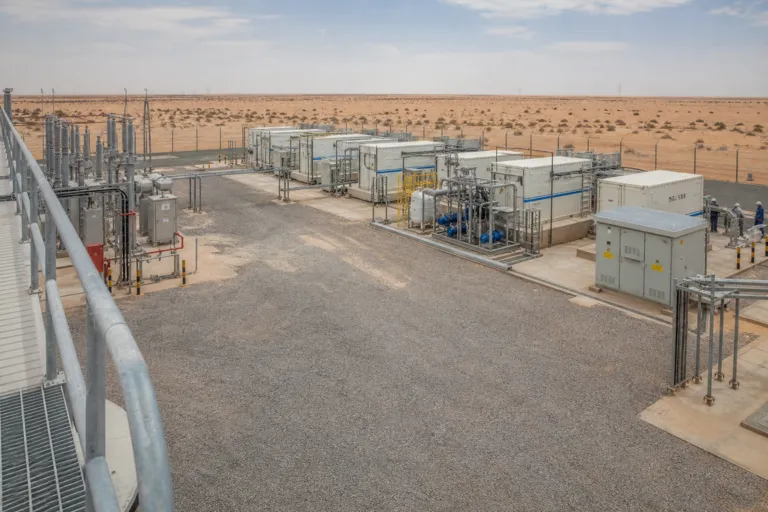
Saudi Arabia’s flow battery energy storage market is described as being in an early commercial phase as of 2026, with demand tied to Vision 2030 renewable energy targets and the need for long-duration storage in the 4–12 hour range to firm solar and wind generation. Total installed flow battery capacity is estimated at 50–80 MWh as of early 2026, largely from pilot and demonstration projects. Demand is concentrated in utility-scale grid storage and renewable integration, with commercial and industrial backup and microgrid use cases emerging in remote mining and desalination sites. In this context, interest in vanadium-linked storage is less about a single device and more about an end-to-end value chain that includes electrolyte, system integration, safety, and grid interface requirements.
Within Saudi Arabia’s installed base, Vanadium Redox Flow Batteries (VRFBs) account for over 85% of installed flow battery capacity, supported by their positioning for long cycle life (20+ years) and safety advantages in high-temperature desert environments. The same Saudi-focused analysis estimates total installed costs for flow battery systems at $350–$550 per kWh of energy capacity for 4-hour systems, with electrolyte representing 30–40% of total system cost. For 6-hour VRFB systems, levelized cost of storage (LCOS) is estimated at $0.12–$0.18 per kWh, and is framed as competitive with lithium-ion for durations above 4 hours. Separately, one market forecast projects the Saudi VRFB market growing from USD 1.9 billion in 2025 to USD 6.8 billion by 2032, at a CAGR of 19.8%.
What “Long-Duration” Means for Procurement and the Vanadium Question
Procurement signals suggest that duration requirements are moving beyond the 2–4 hour norms typical for many lithium-ion deployments. Saudi Arabia’s solar-dominated grid is described as requiring longer discharge durations, and flow batteries are increasingly specified in RFPs for 6-hour and 8-hour projects, with some tenders requiring 10-hour capacity for off-grid mining operations. The long-duration storage market in Saudi Arabia is projected to exceed 5–8 GWh by 2035, and government procurement mandates under the NREP and the Saudi Green Initiative are described as creating a pipeline of 200–400 MWh of flow battery projects by 2028, with the first gigawatt-scale tender expected by 2030. Another Saudi-focused next-generation batteries report adds that grid-scale long-duration projects, particularly for 8–12 hour vanadium flow systems, represent a near-term opportunity, with 5–10 GWh of tenders expected by 2028.
Against that demand outlook, the upstream reality remains clear. As of 2026, the Saudi market is structurally import-dependent, with no domestic vanadium mining or electrolyte production, and stack components, membranes, and power conversion systems sourced from international suppliers in China, Japan, Germany, and the United States. Observed bottlenecks include vanadium feedstock availability and price volatility, specialized membrane manufacturing capacity, skilled EPC firms with flow battery experience, and certification and standardization for grid interconnection. Developers are also exploring electrolyte leasing arrangements where a third party owns the vanadium electrolyte and leases it over the system’s life; this approach is described as lowering initial capex by 25–35%. For decision-makers tracking vanadium in Saudi Arabia, the core question is whether future upstream localization can follow a market that is already signaling multi-hour, grid-scale procurement.
Regional context points to Saudi Arabia’s central role in advanced storage deployment. A Middle East next-generation batteries report describes Saudi Arabia as the largest market, driven by a Vision 2030 target of 50% of electricity from renewables by 2030 and the NEOM giga-project. In that regional outlook, flow batteries (including vanadium and organic) are projected to hold a 20–30% share, favored for long-duration 8–12 hour grid-scale applications where cycle life and safety are critical. The same regional report notes a 200 MWh sodium-ion system in Saudi Arabia’s NEOM region, underscoring that multiple chemistries are being pursued in parallel. The practical implication is that vanadium-based projects compete within a broader procurement landscape, even as VRFBs currently dominate installed flow battery capacity in-country.
How much flow battery capacity is installed in Saudi Arabia as of early 2026?
What share of Saudi Arabia’s installed flow battery capacity is VRFB?
Is Saudi Arabia producing vanadium or electrolyte locally yet?
What project pipeline and tender signals support long-duration storage in Saudi Arabia?
What does the vanadium Saudi Arabia supply-chain challenge mean for project economics?