Any discussion of platinum group metals Saudi Arabia sits inside a broader precious-metals investment and industrial-demand backdrop. IMARC Group values the Saudi Arabia precious metals market at USD 7.6 Billion in 2025 and estimates it will reach USD 12.9 Billion by 2034, with a CAGR of 6.02% from 2026–2034. IMARC also links demand to industrial sectors including electronics, automotive, and healthcare, while highlighting safe-haven investment behavior. In that same macro context, IMARC reports Saudi central bank reserves increased 2.8% from a year ago to SR1.69 Trillion (USD 450.31 Billion) in November, helped by Saudi Aramco’s USD 31.1 Billion dividend on 21st January 2025. Those details do not quantify PGM demand directly, but they do describe the financial and industrial environment in which platinum and related catalysts are procured.
For Saudi-specific platinum scope, IndexBox’s Saudi Arabia Platinum Market Report 2026 defines a product boundary that is tightly tied to catalysis and industrial use: unwrought platinum, semi-manufactured platinum, platinum powder, and platinum catalysts in wire cloth or grill form. The same source explicitly excludes platinum scrap and waste, platinum jewellery, platinum coins and bullion for investment, platinum compounds and salts, and finished automotive catalytic converters. It also outlines application categories that matter for industrial planning in the Kingdom: catalysis, electrical and electronics, glass manufacturing, chemical processing, and medical devices. The report’s statistical framework references HS 711011, 711019, and 711510, and states that historical coverage runs from 2012–2025 with forecasts from 2026–2035.
Catalysts and Hydrogen: Reading Saudi Potential Through Global Signals
Global PGM indicators help frame what Saudi buyers may see in pricing, availability, and technology pull. IndexBox states that, under a baseline scenario for 2026–2035, total global PGM demand is projected to grow at a CAGR of approximately 2.8% through 2035, with the market index reaching 132 (2025=100). The same analysis ties growth support to chemical and hydrogen sectors, while noting that traditional automotive catalyst demand is being reshaped by gradual electrification and tightening emissions regulations. IndexBox also describes supply as heavily concentrated in South Africa and Russia, and says secondary supply from recycling of spent automotive catalysts is growing but cannot fully offset primary production constraints. For Saudi Arabia, these points translate into a practical message: catalysts and hydrogen-linked procurement may face global volatility even when local project demand is steady.
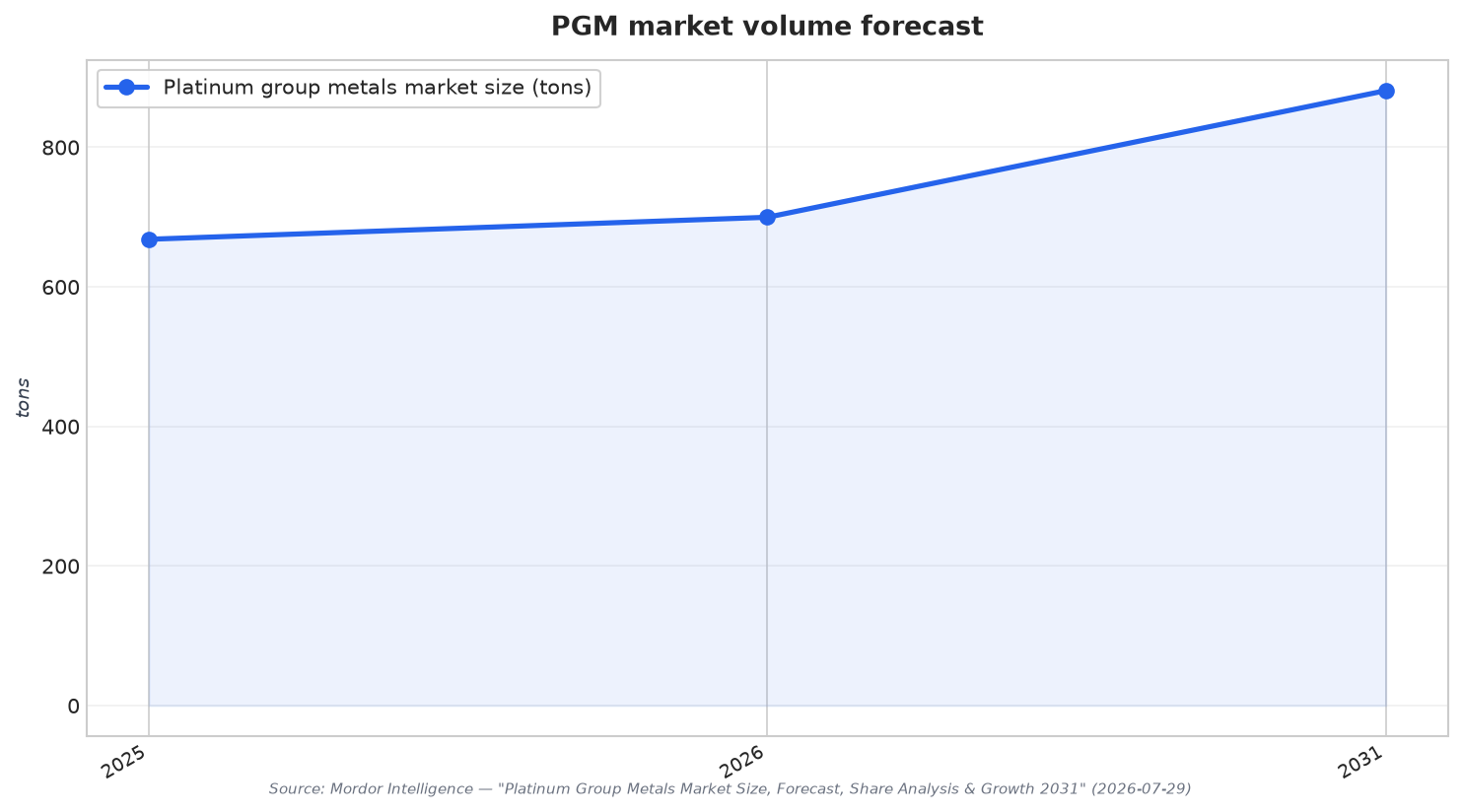
Other global forecasts highlight how fast demand mixes can change. Mordor Intelligence values global PGM market size at 668.23 tons in 2025 and estimates growth from 699.77 tons in 2026 to 881.26 tons by 2031, at a CAGR of 4.72% for 2026–2031. In the same source, automotive commanded 59.25% of end-use volume in 2025, while renewable energy and hydrogen are projected to grow at 9.32% through 2031. Mordor also reports platinum demand for hydrogen climbed from 40 thousand ounces in 2023 to an expected 476 thousand ounces by 2028, with PEM systems contributing most of the rise. Meanwhile, Future Market Insights estimates platinum represents 38.0% of product type in 2026, projects automotive catalysts at 42.0% of application in 2026, and forecasts primary mining at 71.0% of source in 2026. Saudi stakeholders can use these global shares as context, not as local facts, when assessing where catalytic and hydrogen programs could pull on supply chains.
Pulling the threads together, Saudi Arabia’s near-term PGM opportunity is best understood as an industrial procurement and value-chain question, not only a commodity-price story. The Kingdom has a defined analytical lens for platinum that includes catalyst forms (wire cloth or grill) alongside unwrought and semi-manufactured material, with applications spanning chemical processing and electronics. At the same time, global PGM outlooks describe hydrogen as a meaningful demand corridor and describe supply concentration risks that can shape availability and pricing for importers. For strategy teams, the practical next step is to map Saudi end-uses such as chemical processing, electronics, and catalysis against global demand growth signals and supply constraints, using product-specification clarity to reduce substitution and qualification risk.
What does the Saudi platinum market scope include in the IndexBox report?
How fast is global PGM demand projected to grow through 2035?
What do sources say about hydrogen’s influence on platinum demand?
How do automotive and hydrogen compare in global end-use trends for PGMs?
How should readers interpret the topic of platinum group metals and Saudi Arabia based on these sources?