In Saudi Arabia, the hardest part of building a mine can be what surrounds it. S&P Global notes that operational risks are heightened by water scarcity and infrastructure gaps in remote mining regions, which can force substantial investment in desalination, recycling, and the development of roads, power, and communications. That risk profile matters as the Kingdom advances Vision 2030 and positions mining as a cornerstone of economic diversification. The Arabian Shield is described as underexplored, and exploration outcomes can be uncertain due to geological complexity, limited historical data, and technical challenges. In this context, de-risking remote deposits is as much an infrastructure question as it is an exploration one.
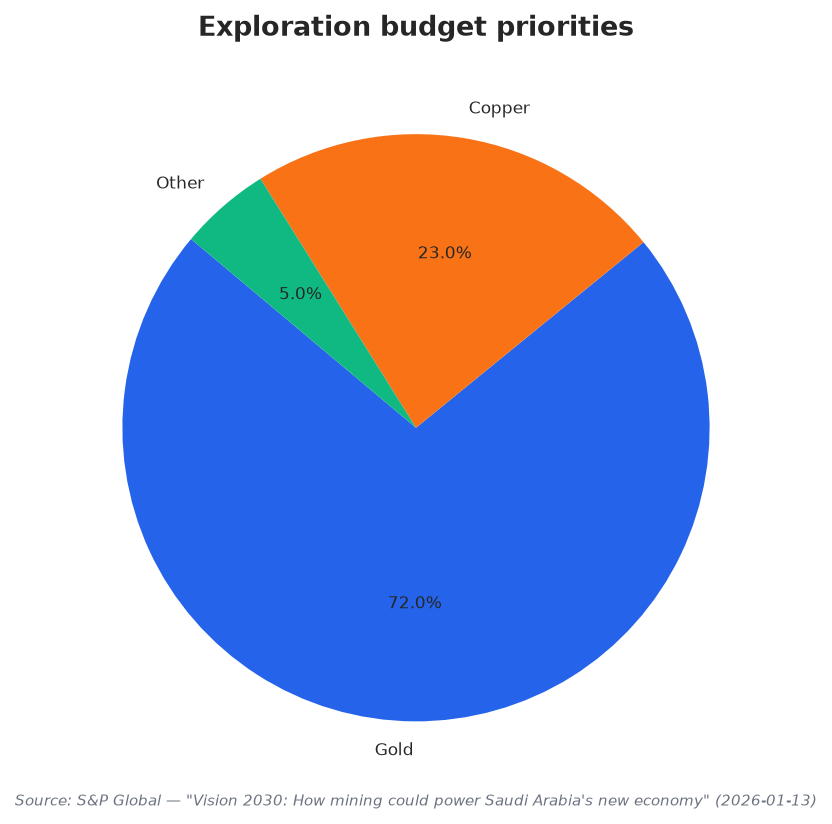
The urgency is visible in activity levels and allocation choices. In 2025, S&P Global reports that 72% of the total exploration budget went to gold and 23% to copper, reflecting evolving priorities. It also states the Kingdom hosts 24 exploration projects and 17 advanced projects, and that the number of projects drilled increased to 160 in 2024 from 58 in 2023. Those figures point to a faster-moving pipeline, where investors and operators need clearer line-of-sight on what it will take to supply water, connect to power, and move inputs and output over long distances. This is where coordinated infrastructure provision becomes a direct lever on development timelines and financing confidence.
From Infrastructure Uncertainty to Bankable Readiness
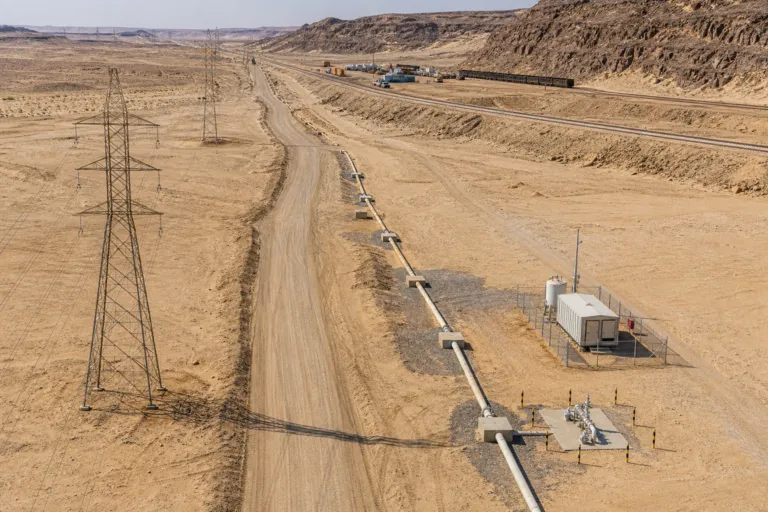
One flagship example is the Jabal Sayid project, described as a demonstration of the infrastructure-led development model. Discovery Alert reports a treated water transmission system delivering 15,000 cubic metres daily through a 75-kilometer pipeline network, with capacity to support up to five potential mining sites across the Al-Mahd governorate region in the Madinah region. The same source states this engineering solution delivers a 60% decrease in water supply expenses. It also highlights an infrastructure readiness classification system that categorizes mining license applications into Categories A, B, and C based on power access, water availability, and transportation connectivity. By turning basic services into a planned platform, the initiative targets the specific uncertainties that often stall remote mine investment decisions.
The infrastructure buildout is also framed as an operational and environmental shift. Discovery Alert states that eliminating water tanker transport displaces approximately 11 million barrels of oil equivalent and reduces carbon dioxide emissions by 4 million tonnes annually. This matters because remote operations often rely on costly, complex logistics, and reducing that dependence can change both cost structure and risk exposure. The same source points to partnership mechanisms, including coordination between the Ministry of Industry and Mineral Resources and the Saudi Authority for Industrial Cities and Technology Zones (MODON), as part of integrated planning. In parallel, Discovery Alert emphasizes that much of the Arabian Shield’s most prospective terrain can sit in areas with limited existing infrastructure, meaning power, water, and transport connectivity can extend lead times and require capital that must compete with other priorities.
Broader infrastructure momentum provides context for how mining corridors can be supported. Metastat Insights values the Saudi Arabia infrastructure market at USD 81.6 billion in 2025 and projects a 7.8% CAGR during the forecast period. Mordor Intelligence adds that new schemes held an 82% stake of the Saudi Arabia infrastructure construction market in 2024, and it describes extraction-related infrastructure such as expanded haul roads, slurry pipelines, and off-grid power facilities attracting specialized EPC consortia. Together, these signals help explain why the Saudi Arabia mining infrastructure enablement initiative is positioned as a de-risking tool: it shifts remote deposits from “maybe feasible” to “planned and connectable,” aligning water, power, and roads with the faster drilling and licensing cadence already underway.
Why do remote mining projects in Saudi Arabia face higher operational risk?
What are the key specs of the treated-water system linked to Jabal Sayid?
How does the infrastructure readiness classification system work for mining licenses?
How fast is exploration activity growing in Saudi Arabia?
How does Saudi Arabia’s mining infrastructure enablement initiative reduce risk for remote deposits?