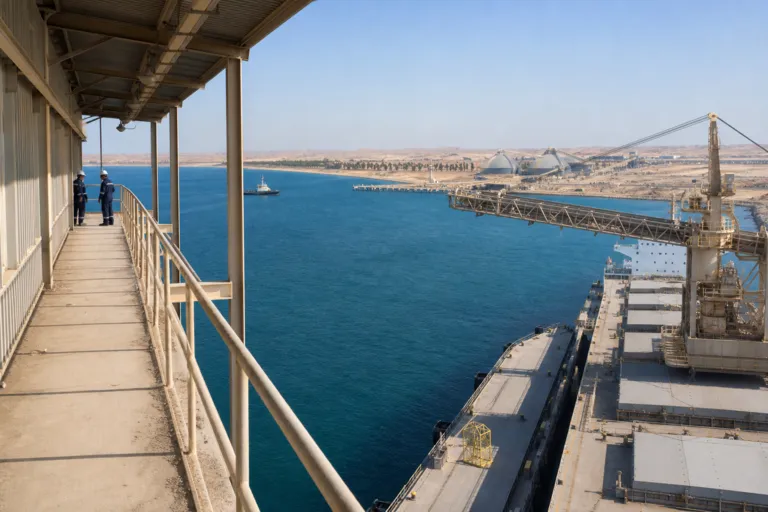
Saudi Arabia and India are moving from ad-hoc fertilizer buying toward a more durable corridor model. Saudi Industry Minister Bandar Al Khorayef and India’s Fertilizers Minister JP Nadda met to tighten cooperation on phosphate and fertilizer supply and to open the door to private-sector participation, according to Saudi state news agency SPA. The stated goal is to bypass volatile spot markets with a structural bilateral arrangement, at a time when war-driven repricing has made short-notice sourcing harder. For India, fertilizer import costs can flow into subsidy spending, which makes supply stability a policy issue as much as a procurement one.
The urgency shows up in tender activity and pricing signals. State-run Indian Potash Ltd (IPL) secured over 400,000 tons of diammonium phosphate (DAP) from Saudi suppliers including Maaden and VB Venture in a single tender. The same reporting also describes purchases of 765,000 tons at about USD 930 a ton for west coast delivery and another 581,000 tons at roughly USD 935 per ton for the east coast, after bids came in at nearly double the initial tender size. The corridor logic is clear: a single tender absorbed roughly a quarter of India’s annual DAP imports, while India was described as on track to import a record 1.35 mn tons of DAP this season amid tighter global availability.
From Phosphate to Strategic Minerals: Why the Corridor Can Broaden
Saudi Arabia’s pitch rests on scale and on building an “anchor relationship” with a major buyer. The Kingdom is described as home to 7% of global phosphate reserves, and direct access to Maaden’s Wa’ad Al Shamal complex is framed as a hedge for Delhi against expensive Moroccan imports and against Russian supply chains exposed to sanctions risk. The supplier base for the record DAP tender was reported as largely Saudi Arabia, Egypt, Morocco, and Russia, but Saudi phosphate scale and the bilateral framework were positioned as central. Separately, Egypt’s producers were reported to have secured a 15% share of an international tender to supply India with 2.5 mn tons of nitrogen fertilizers in June, underscoring how regional supply networks are being rewired.
The fertilizer corridor also sits alongside Saudi Arabia’s push to expand mining and downstream processing, creating a second pillar for cooperation. Saudi mining exploration spending reached a record 1.05 billion riyals (USD 279.8 million) in 2024, driven by a surge in private sector spending, according to data released by the Ministry of Industry and Mineral Resources (MIM). In that wider critical-minerals context, Indian multinational Vedanta announced plans in November 2024 to invest USD 2 billion in Saudi Arabia for three projects for the “red metal,” including a 400,000 tonnes per year greenfield copper smelter and refinery and a 300,000 tpy copper rod project. Maaden also announced a strategic joint venture with MP Materials and the US Department of War to develop a rare earths refinery in Saudi Arabia.
What emerges is a corridor concept that links food security inputs with energy-transition materials and industrial upgrading. Research focusing on the Arabian Peninsula highlights the Arabian Shield as host to significant deposits of phosphates, copper, gold, and critical minerals, and notes untapped critical minerals including Cu, Li, Co, and Ni, while also pointing to Saudi Vision 2030 targets around mining diversification. On the fertilizer side, market tracking shows Saudi Arabia’s fertilizer market was valued at USD 0.86 billion in 2026 and projected to reach USD 1.1 billion by 2031 at a 5.03% CAGR, while another report describes a 6.2% CAGR forecast for 2025-2032 and notes that around 80% of Saudi food requirements are met through imports. Together, these signals explain why a Saudi-India corridor across the Arabian Sea can be framed as both a supply-security project and an industrial strategy.
What does the Saudi-India fertilizer corridor aim to change versus spot buying?
What volumes and prices were cited in India’s recent DAP tender activity?
Why is Saudi Arabia positioned as a structural phosphate supplier in this corridor?
How does a Saudi Arabia–India critical minerals corridor connect to mining investment in the Kingdom?
What critical-minerals processing initiatives were mentioned for Saudi Arabia?