Saudi Arabia already buys and operates machinery through a mix of global OEMs, local assemblers, authorized distributors, EPC procurement channels, and specialist service providers. Demand is anchored to capital expenditure across construction, energy, mining, utilities, and manufacturing, which creates a steady pull for heavy fleets and the parts-and-service ecosystems behind them. One signal of scale is import intensity: Saudi machinery and electrical equipment imports represented 30.0% of total imports in Q3 2025. For suppliers, this points to a market where availability, delivery reliability, and lifecycle support can be decisive—especially when the end user needs uptime more than a one-time purchase.
The investment pipeline is also visible in market outlooks. One report places the KSA Machinery and Equipment Market at USD 25.6 billion in 2025 and projects growth to USD 39.9 billion by 2031, a forecast CAGR of 7.67%. The same source notes import dependence of 78.0% in 2025, with expectations that local assembly, remanufacturing, and component sourcing could reduce that to approximately 69.0% by 2031. That shift matters for heavy mining equipment because it reframes the opportunity: localization is not just about building new machines, but also about rebuild programs, component manufacturing, and rapid parts availability that can keep high-value assets productive.
Why a Saudi Heavy Mining-Equipment Base Fits the Demand Map
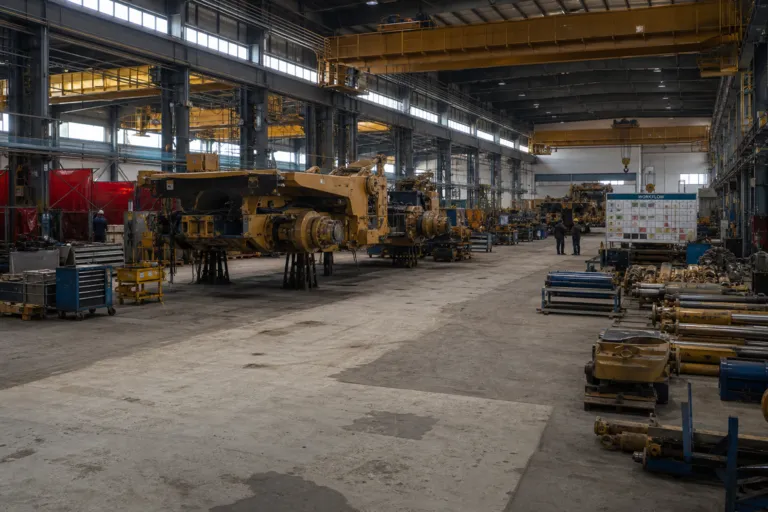
Demand drivers are not isolated to one region or one project category. Riyadh, the Eastern Province, and the Western industrial corridor are described as principal commercial hubs, each with a different role—Riyadh concentrates government procurement and giga-project management, while Dammam and Jubail support oil, gas, petrochemical, and process-equipment demand. MODON manages more than 4,000 productive, existing, and under-construction factories and approximately 8,000 industrial and investment contracts. For a localized mining equipment platform, that installed base supports shared services: machining, welding, foundry work, hydraulics, electrical integration, testing, and technician training that can serve mines and adjacent industries.
Mining-specific procurement signals are strengthening. Saudi Arabia’s mineral processing equipment market is expected to reach USD 198.13 million in 2025 and grow at a CAGR of 10.87% to reach USD 331.91 million by 2030. The same source cites revised national resource estimates of USD 2.5 trillion and 73 new exploration licences, which intensify equipment tenders, including in the Eastern Province where rail and port links can reduce logistics cost for oversized machinery. It also notes joint ventures that deepen localization—such as Weir–Olayan focused on pump refurbishments and mill-liner casting, plus Epiroc-Rasi targeting autonomous drilling—showing that local capability is already moving beyond distribution toward repair, casting, and advanced systems.
A manufacturing base becomes even more compelling when linked to fleet categories that overlap construction and mining. Saudi Arabia’s heavy construction equipment market is valued at USD 17,545 million in 2026 and projected to reach USD 24,627 million by 2031, at a 4.6% CAGR, with ongoing demand for excavators, loaders, dozers, and specialized machinery. Another source values the broader Saudi construction equipment market at USD 27,025.9 million in 2024 and projects USD 40,163.1 million by 2033, at a 4.5% CAGR. These adjacent segments help justify shared manufacturing lines, component supply chains, and service bays—especially because profit pools are expected to expand most in spare parts, field services, monitoring, rebuilds, and performance-based maintenance.
What supports the case for mining equipment manufacturing in Saudi Arabia?
How large is the KSA machinery and equipment market, and what is the forecast?
How is import dependence expected to change with localization?
What does the mineral processing equipment outlook imply for local suppliers?
Which regions and industrial platforms can anchor localized production and service?