Building a domestic gold refinery in Saudi Arabia is not just about pouring bars. It is about converting mined doré into bullion that counterparties can settle as allocated gold. Doré is described as a semi-refined casting that typically arrives well below investment standards, running about 60–90% fine, with much of the balance in silver and base metals such as copper, iron, and lead. Another description places doré commonly around 80% gold, again with silver as most of the remainder and smaller amounts of base metals. In wholesale markets, London Good Delivery starts at 995.0 parts per thousand fine gold, while market preference commonly sits at 999.9. This gap is where refinery capability, assay discipline, and bar identity systems become central.
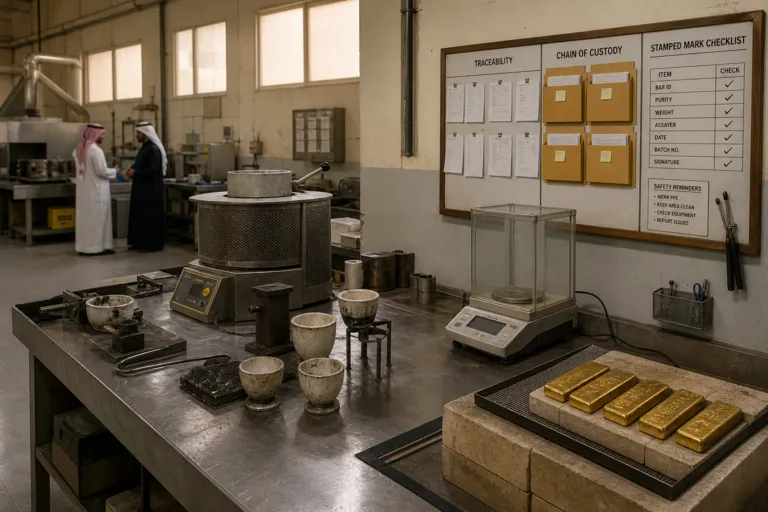
The practical work begins with intake. An accredited refiner records what the material is at intake, such as mine doré, investment-grade scrap, or Good Delivery bars returned for re-casting. That intake step links directly to responsible sourcing expectations. The refining process description ties due diligence to the OECD due diligence framework and to the LBMA Responsible Gold Guidance, which it notes is currently version 9, finalised in November 2021. Refining then follows a fixed sequence: intake, melt and assay, primary refining, optional high-purity refining, then casting and marking. The same source describes established chemistry choices, from chlorination at roughly 995 to electrolysis at 999.9 and above, but stresses that modern reporting and provenance expectations are rising alongside the technical steps.
What LBMA Good Delivery Requires — Bars, Marks, and Ongoing Oversight
LBMA Good Delivery is described as the international benchmark standard for the professional bullion market. It specifies the form, weight, fineness, and markings of bars traded between accredited institutions, and it also defines who is allowed to make them through the Good Delivery List. The Wikipedia summary of the rules lists gold bar fineness at a minimum of 995.0 parts per thousand fine gold and a gold content range of 350–430 troy ounces (11–13 kg), with recommended top length of 210–290 millimetres, width of 55–85 millimetres, and height of 25–45 millimetres. Required marks include a serial number, the refiner’s hallmark, fineness, and year of manufacture. Weight is not recommended to be stamped because the officially weighed delivery weight prevails and can differ after handling or sampling.
For a Saudi Arabia refinery, the institutional hurdle is listing and staying listed. Only refineries on the LBMA Good Delivery List are authorised to produce bars recognised as Good Delivery. Maintaining that status is described as requiring consistent production quality and assay accuracy, secure logistical and environmental standards, regular Proactive Monitoring (PAM) audits, compliance with OECD Due Diligence Guidance, and submission of independent assay samples for verification by LBMA referees. The system also relies on periodic re-weighing and visual inspection inside LBMA-accredited vaults, with bars withdrawn and re-assayed if discrepancies appear. In addition, assay laboratories are described as maintaining calibration under ISO/IEC 17025 standards. From a market mechanics view, Good Delivery underpins settlement via book-entry transfers within the London Precious Metals Clearing Limited (LPMCL) framework, so bar identity and trust substitute for repeated re-assay.
This context matters in Saudi Arabia because local production and international trade dynamics are part of the backdrop for investment decisions. A Saudi market report describes significant trade flows, with the United Arab Emirates as the dominant partner for both imports and exports, and it notes that from 2020 to 2024 import prices rose sharply while export prices declined. On the supply side, Saudi Gold Refinery (SGR) describes itself as one of three gold producers operating in Saudi Arabia, with significant growth plans that include two pre-feasibility projects and 15 exploration projects, and it states it has more than 200 exploration licences under application. For domestic refining ambitions, the strategic prize is not a headline figure, but the ability to turn doré into bars that meet the 995.0 threshold, carry compliant marks and traceability, and can ultimately be accepted as Good Delivery across institutional vault and settlement networks.
What fineness does LBMA Good Delivery require for gold bars?
What is doré, and why can’t it trade as investment bullion?
What marks must appear on a Good Delivery gold bar?
How does a gold refinery in Saudi Arabia work toward Good Delivery status?
What do the sources say about Saudi Gold Refinery (SGR) plans in the Kingdom?