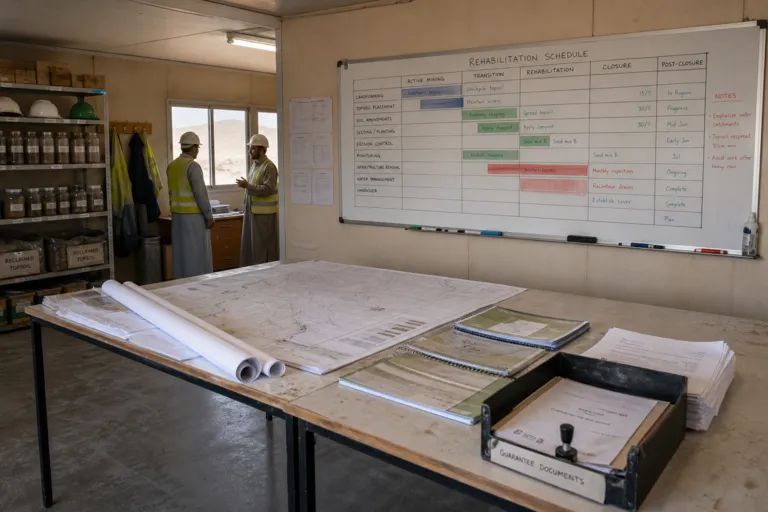
Mine closure bonds in Saudi Arabia sit inside a broader regulatory shift that is designed to make the sector investable while keeping environmental duties enforceable. Saudi Arabia’s Mining Investment Law, issued in 2020, governs mineral ownership, exploration licences, mining licences, and environmental obligations across the Kingdom. The framework applies to the full lifecycle, from early-stage activity through development, production, and mine closure. It also sets the legal foundation for state ownership of mineral resources and the licensing system that controls access to them. In the same reform arc, the Executive Regulations issued by the Ministry of Industry and Mineral Resources add practical structure, including financial guarantees and fee structures, alongside provisions on environmental protection, mine closure, and rehabilitation obligations.
This approach matters because Saudi Arabia is actively repositioning mining as a core part of economic diversification. The Mining Investment Law is described as the legal foundation for turning the Arabian Shield’s estimated $2.5 trillion mineral endowment into a functioning non-oil pillar under Vision 2030. Market commentary also links mining’s growth outlook to responsible resource management and effective ESG practices, since global investors increasingly prioritize environmental stewardship, workforce safety, and community engagement. In that context, financial assurance is not a side policy. It becomes part of the confidence package that sits next to licensing clarity, competitive licensing rounds, and the broader push to attract domestic and foreign investment.
What Financial Assurance Covers from Licensing Through Closure
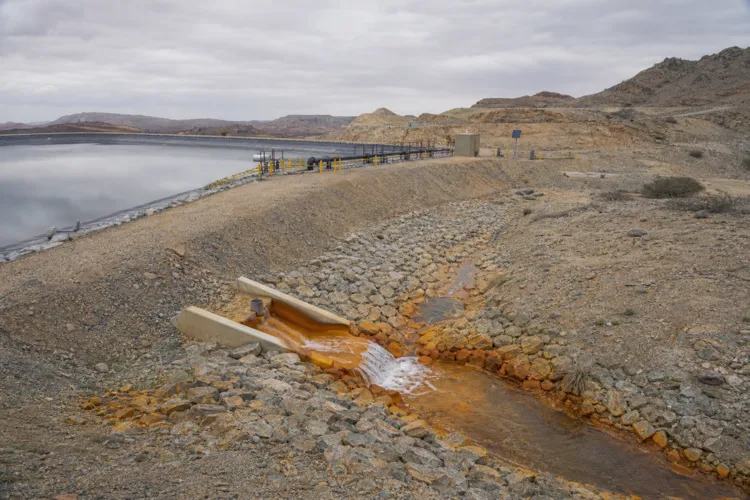
Financial assurance is easiest to understand when it is connected to what regulators actually expect to happen at the end of mining. A comparison point from African jurisdictions explains that rehabilitation bonds are designed for end-of-mine-life restoration activities such as soil remediation, water treatment system installation, and ecosystem reconstruction. The same source emphasizes that these mechanisms serve dual purposes: they give regulators confidence that rehabilitation will occur post-closure, while also protecting operators from catastrophic financial liability. That framing aligns with Saudi Arabia’s lifecycle orientation. Environmental management systems are expected to address all phases from exploration through closure and rehabilitation, supported by comprehensive environmental assessment that identifies mitigation requirements and ensures compliance.
Saudi Arabia’s updated mining regime is explicitly described as simplifying the licensing process through clearer concession types and introducing competitive licensing rounds, while setting out financial guarantees and fee structures. Those guarantees sit alongside mine closure and rehabilitation obligations, which is the practical link between issuing a licence and enforcing a credible closure outcome. Internationally, structured funding tools can also include managed funds with governance guardrails. One example is South Africa’s Section 10(1)(cH) trusts, described as requiring operator capital deposits into managed funds administered by independent trustees, with annual audit requirements and independent cost estimate updates. Saudi Arabia’s sources do not specify that exact model, but the example shows how financial assurance can be operationalized to make closure plans more than a written promise.
Closure and rehabilitation funding is also a live topic globally because the scale of restoration work is expanding. A global market forecast projects the mine rehabilitation market reaching $14.3 billion in 2034, from $8.1 billion in 2025, at a CAGR of 6.5%. Public funding can be significant as well. The same report cites a Canadian government announcement of a $12.1 billion critical minerals investment package in March 2026, with a significant allocation toward site rehabilitation in regions such as British Columbia. Saudi Arabia’s policy context is different, but the comparison highlights why clear financial guarantees and closure obligations can support both environmental outcomes and investment confidence as the Kingdom advances its Vision 2030 mining agenda.
How do mine closure bonds in Saudi Arabia fit into the Mining Investment Law?
What problem does financial assurance solve for mine rehabilitation?
What types of closure work are rehabilitation bonds commonly tied to in other jurisdictions?
Is there evidence that rehabilitation funding is a growing global priority?