The conversation around electric haul trucks in Saudi mining is shifting from curiosity to planning. In a wider regional context, mining electrification projects across South Africa, Saudi Arabia, and the United Arab Emirates increased electric heavy equipment deployment by 26%, showing that adoption is moving beyond isolated trials. In Saudi Arabia specifically, the commercial vehicle electrification market (trucks and buses) is valued at USD 1.2 billion, supported by government initiatives, rising fuel prices, and sustainability goals. Yet the transition is uneven. Public transport leads, while construction and mining are described as slower to electrify, which makes the business case in mines hinge on site-by-site practicality, rather than broad mandates.
For mine operators, the operational upside is increasingly tied to emissions reduction and productivity, not just brand positioning. A market report notes underground mining operators reduced diesel emissions by 43% after integrating battery-electric haul trucks into extraction operations. The same report also links autonomy with performance: during 2025, autonomous electric mining trucks improved hauling efficiency by 24% and reduced labor dependency by 19%. Those are not Saudi-only figures, but they help quantify what leading deployments are targeting. For a Saudi mine, the relevant takeaway is that electrification can be a combined operations play—lower diesel emissions plus measurable efficiency gains where autonomy and fleet management are mature enough to support it.
Charging Reality: Cost, Speed, and Remote-Site Constraints
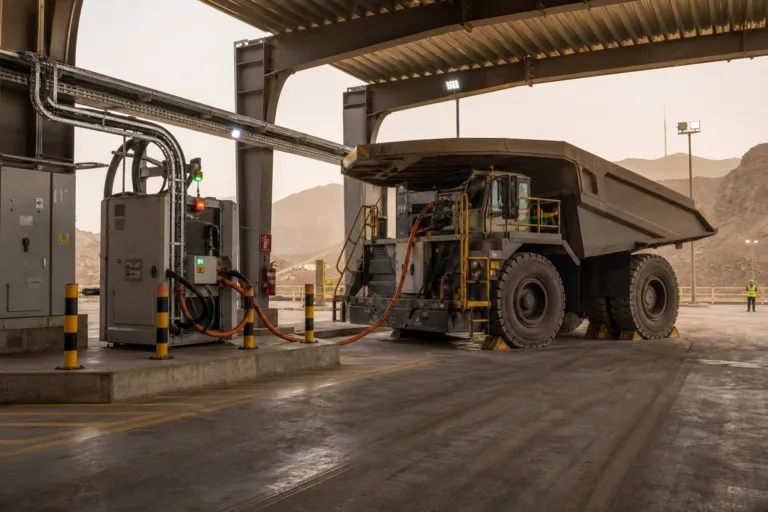
Charging is where the strongest objections and the most promising solutions meet. One report states charging infrastructure installation costs for mining operations exceeded traditional fueling systems by 29%, and more than 42% of construction contractors delayed electrification due to charging network limitations at remote project sites. For intensive mining use, battery replacement cycles averaged 6 years, creating operational expenditure concerns among fleet operators. At the same time, fast-charging systems delivering 350 kW power output were installed at over 2,700 industrial facilities worldwide during 2025, and battery-swapping stations for mining vehicles increased by 26% globally. The business case in Saudi mines improves when charging is designed as core infrastructure, not an add-on.
Saudi infrastructure planning is also advancing toward higher-power standards suited to heavy duty cycles. A Saudi megawatt charging system (MCS) report defines MCS as charging capacities exceeding 1 MW, typically operating at 1,000V–1,500V DC, designed to charge electric heavy-duty vehicles—including trucks, buses, and mining equipment—in 15–30 minutes. It explicitly cites mining operations in the Eastern Province and the Arabian Shield as a demand vector, alongside long-haul trucking and municipal buses. By 2030, the transport and logistics sector is expected to account for 40–50% of MCS unit demand, while mining companies are described as emerging buyers for remote mine-site deployments. This aligns with a practical procurement logic: private fleet operators typically buy MCS through capital equipment budgets with payback periods of 3–5 years based on fuel and maintenance savings.
The financial argument often becomes clearest when compared with diesel-heavy operations elsewhere. In Australia, Fortescue ordered 360 battery electric haul trucks as part of a USD 4 billion deal with Liebherr to electrify iron ore mines, and an analysis states electric haul trucks could save Fortescue over USD 400 million in fuel per year. Saudi Arabia’s market context is different, but local cost barriers are documented too: electric trucks are priced around SAR 300,000 (USD 80,000) compared to SAR 200,000 (USD 53,000) for diesel counterparts. Saudi Arabia is also investing SAR 1.5 billion in electric vehicle infrastructure by 2025, and the country has 1,200 public charging stations cited as a constraint for broader adoption. For mining fleets, the core decision becomes how much on-site charging and operational redesign can offset higher upfront vehicle costs.
What is driving interest in electric haul trucks for Saudi Arabia’s mining sector?
What performance improvements are associated with battery-electric haul trucks in mining?
What are the biggest infrastructure hurdles for battery haulage at mine sites?
How does megawatt charging change the outlook for electric haul trucks in Saudi mining?
What does it cost to buy an electric truck in Saudi Arabia versus a diesel truck?