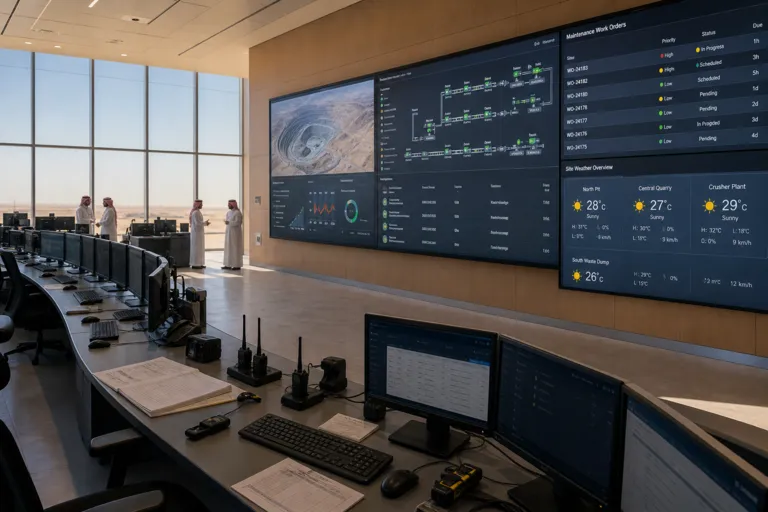
Saudi mining is being pulled in two directions at once. Operators are chasing deposits in remote regions, and they also need tighter control over productivity, maintenance, and safety. One signal of the remote push is that Ken Research estimates 20% of Saudi Arabia’s mineral resources are located in remote areas. At the same time, market commentary points to equipment becoming more connected, with transportation and hauling tools integrating telematics and remote operation modules, while processing equipment evolves toward automation and real-time monitoring. This mix creates a natural role for integrated remote operations centers that can oversee multiple sites, standardize workflows, and keep decision-making close to management teams in Riyadh.
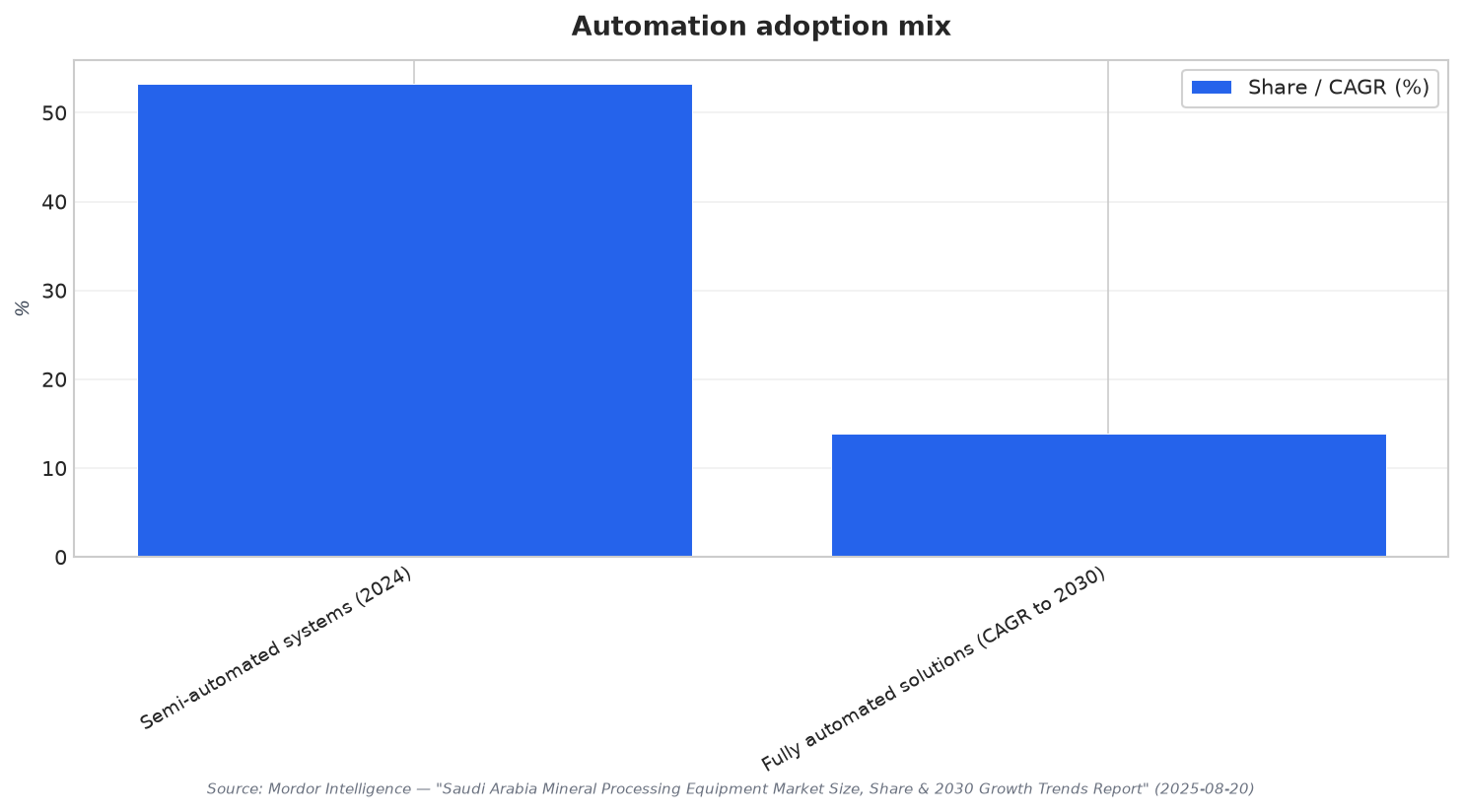
Capital flowing into mines and plants adds another reason to centralize operations. Mordor Intelligence values the Saudi Arabia mineral processing equipment market at USD 198.13 million in 2025 and forecasts USD 331.91 million by 2030, a 10.87% CAGR. The same report notes surface extraction held 76.87% share in 2024, while underground techniques are advancing at an 11.28% CAGR through 2030. On the automation side, semi-automated systems held 53.28% share in 2024, but fully automated solutions are expanding at a 13.83% CAGR through 2030. As new capacity comes online, centralized control becomes a way to keep performance consistent across different mining methods and automation levels.
Why Integrated Remote Centers Fit Saudi Arabia’s Automation Drive
In global context, remote operation centers are becoming mainstream infrastructure for mining. A 2026 overview on remote operation centers states that by 2025, over 60% of new mining sites will integrate Remote Operation Centers for real-time data and automation. The same source adds that remote operation centers can reduce on-site personnel in mining by up to 50% by 2026, positioning them as a safety and efficiency lever when hazards, distance, and staffing constraints collide. For remote operations center mining Saudi Arabia strategies, the logic is straightforward: connect sensor-rich equipment, push real-time data into a secure operations environment, and allow engineers and controllers to support multiple sites without placing every specialist at the mine.
Saudi-specific equipment trends reinforce that logic. Ken Research values the Saudi Arabia autonomous mining equipment market at USD 160 million based on a five-year historical analysis, and links growth to automation that enhances efficiency and safety while reducing costs. The same source states that integrating advanced technologies such as AI and machine learning in mining operations is expected to reduce operational costs by up to SAR 1.5 billion annually in future. It also notes that the Saudi government has allocated SAR 1.2 billion for mining sector development initiatives in future, and that investments in these technologies are expected to reach SAR 800 million in future. Those expectations are easier to execute when mines share common monitoring, analytics, and remote support capabilities.
Riyadh’s role is not only symbolic; it is described as an administrative and economic hub in Ken Research’s view of mining equipment demand, alongside Jeddah and Dammam. This hub-and-spoke pattern matters as projects spread across provinces and as processing capacity scales. For example, Mordor Intelligence reports that phosphate processing led with 36.62% revenue share in 2024 within the mineral mining sector, and it highlights Ma’aden processing 11.6 million t/y of phosphate ore at Al Jalamid and Ras Al Khair, with added capacity to reach 16 million t/y under the Wa’ad Al-Shamal expansion. Coordinating assets like these through integrated remote operations centers helps align production, maintenance windows, and reliability practices across long distances.
Why are mines being run from centralized hubs like Riyadh?
How does a remote operations center support mining automation in Saudi Arabia?
What figures suggest remote operations centers are becoming standard in mining?
What cost and investment expectations are linked to advanced mining technologies in Saudi Arabia?