Working in intense heat can overwhelm the body’s ability to cool itself. Heat stress is commonly described as the inability of the human body to dissipate heat effectively, which can lead to heat-related injuries and illnesses that threaten well-being, quality of life, and can even lead to deaths. For operators managing outdoor workforces, that means heat risk is not just a comfort issue. It is a safety system issue that needs planning, supervision, and documentation. In Saudi Arabia’s hot climate, heat exposure during outdoor activities increases the risk of both indoor and outdoor heat stress. Evidence from a summer field assessment in southeastern Saudi Arabia (June–September 2016) emphasizes that this exposure can be intense and prolonged during routine work.
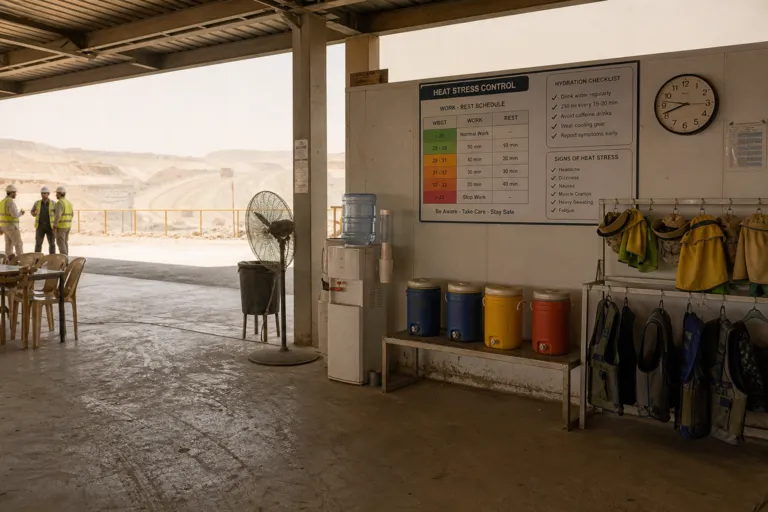
One important lesson from Saudi-focused research is that policy on paper does not automatically reduce exposure in practice. A Saudi study noted that compliance with the midday outdoor work ban proved ineffective in reducing heat-stress risk. For mines and contractors, this is a warning about relying on a single administrative control. Crews may still face hazardous conditions before and after restricted hours, and heat can also carry into indoor or enclosed spaces when equipment, solar load, and poor airflow combine. The practical implication is to build layered controls. These controls should include environmental monitoring, structured rest, hydration routines, cooling options, and training that teaches workers and supervisors how to recognize and respond to heat strain quickly.
A Layered Heat-Stress Plan: Monitor, Train, Enforce, Document
Multiple organizations have issued occupational heat exposure guidelines or standards, including NIOSH, ISO, ACGIH, OSHA, and the American Industrial Hygiene Association. Heat-stress interventions described in a construction-industry gap analysis include acclimatization, environmental monitoring, hydration practices, rest breaks, cooling practices, and training. However, that review also found that many interventions did not achieve a complete reduction in heat-stress illness, which supports using several controls at once rather than betting on a single measure. For Saudi sites, procurement and compliance can reinforce this approach. Market research notes that NEOM, Red Sea Global, and Qiddiya gigaprojects mandate heat-stress protocols for outdoor construction workforces, and it also cites occupational safety mandates from Saudi Arabia’s Ministry of Human Resources and Social Development that support compliance-driven purchasing and implementation.
Instrumented monitoring is becoming a practical backbone for field decisions, especially when multiple contractors share the same workface. The global heat stress monitor market is valued at $0.34 billion in 2025 and is projected to reach $0.70 billion by 2034, expanding at a compound annual growth rate of 8.2% (Dataintelo). Another estimate puts the heat stress monitor market at USD 70.2 million in 2025 with a 7.8% CAGR from 2026 to 2035 (GMI). A related category, the heat stress meters market, was valued at USD 120 million in 2025 and is estimated to reach USD 200 million by 2034 with a 6.1% CAGR (Verified Market Reports). For operations leaders focused on heat stress among mine workers in Saudi Arabia, these figures are not local climate statistics. They are a signal that monitoring tools—often built around WBGT, dry bulb, globe temperature, and relative humidity sensing—are becoming standard across construction and mining environments.
A contractor-ready program should connect those monitors to clear triggers, roles, and records. Assign responsibility for readings, communication, and stop-work decisions. Pair monitoring with worker acclimatization, hydration routines, planned rest breaks, and accessible cooling practices, then reinforce them through training and supervision. Market research also highlights ISO 7243 as a gate for wet-bulb globe temperature accuracy certification, and it notes that accreditation bodies in Germany, the United States, and Saudi Arabia apply divergent testing protocols that can fragment supplier qualification requirements. That makes procurement diligence part of heat safety: buying devices is not enough. Sites need defensible accuracy, repeatable procedures, and documentation that can stand up across multiple employers and contractor tiers.
Why is heat stress a critical safety issue for outdoor crews?
Does a midday outdoor work ban automatically reduce heat risk in Saudi Arabia?
What controls are commonly used in heat-stress prevention programs?
How does the heat stress mine workers Saudi Arabia topic connect to monitoring technology?
What market numbers show growth in heat-stress monitoring tools?