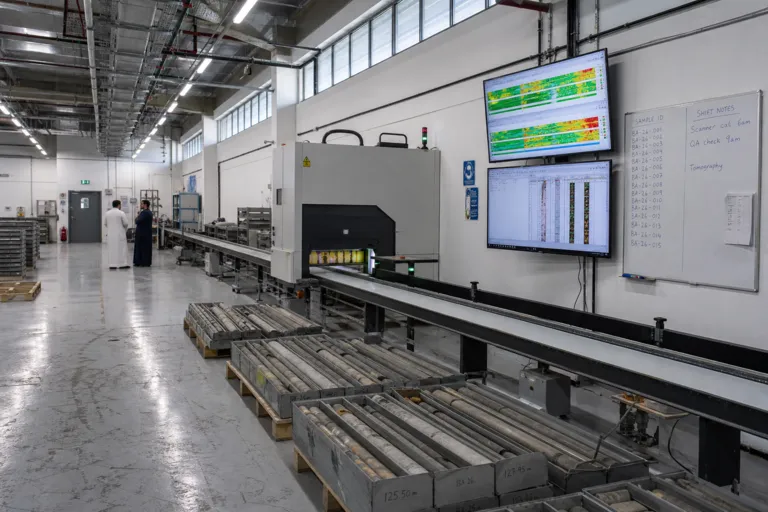
Exploration teams often lose time between drilling and decision-making because core logging, selective sampling, and laboratory turnaround can stretch into weeks or months. New scanning workflows are designed to reduce those bottlenecks by capturing compositional, mineralogical, structural, and photographic data rapidly at the core shed. Modern systems combine hyperspectral imaging, X-ray fluorescence (XRF) scanning, and structured-light 3D capture to create continuous, spatially registered datasets across core trays. This supports earlier interpretation, better targeting, and quicker iteration from drill hole to geological model. For operators focused on drill core scanning in Saudi Arabia, the practical value is speed with traceable digital records that can be reviewed and compared over time.
Saudi Arabia’s broader drilling and equipment environment highlights why shortening the drill-to-decision cycle matters. The Saudi Arabia drilling rigs market was valued at USD 2 Billion in 2024 and is projected to reach USD 3.31 Billion by 2032, growing at a CAGR of 6.5% from 2025 to 2032. In parallel, a drilling-services forecast values the Saudi Arabia Drilling Services Market at $8.7 Billion in 2026 and projects expansion to $15.73 Billion by 2035 at a 6.80% CAGR. These figures reflect a context where more drilling can create more samples, more data, and more pressure on geoscience teams to deliver decisions faster without losing documentation quality.
What Automated Core Scanning Adds to the Logging Workflow
Core scanning tools add different layers of insight that manual logging and selective sampling can struggle to match at scale. Hyperspectral scanning captures reflectance across visible, near-infrared, and shortwave infrared wavelengths, enabling automated mineral identification such as clay species, carbonates, iron oxides, and alteration assemblages, across full core-tray lengths without destructive sampling. XRF and conveyor-based scanning can provide near-continuous elemental profiling along intervals, while LIBS extends coverage to lighter elements that conventional XRF struggles with, including lithium. These datasets do not replace certified laboratory assays for resource reporting, but they help guide selective sampling, flag high-priority intervals for expedited assay, and reduce blind sampling decisions.
Saudi exploration activity is also expanding, making automation and data discipline more valuable. One Saudi exploration update reports drilled projects surging to 160 in 2024 from 58 in 2023. The same source says that in 2025, 72% of exploration budgets targeted gold and 23% focused on copper, alongside 350% growth in awarded exploration licenses and active mining permits reaching 2,485 by August 2025. At the same time, Saudi Arabia’s mining equipment market is estimated at USD 7.32 billion in 2025, forecast to reach USD 9.72 billion by 2030 at a 5.83% CAGR. In that landscape, automated scanning and digital logging can help teams keep pace with more core, more targets, and more stakeholder reporting needs.
Automation in adjacent workflows supports the same goal of compressing decision cycles. A Saudi-focused drilling-services outlook notes that digital rig technology is climbing fastest as real-time analytics compress decision cycles, and it also cites SFDA certification timelines that can extend procurement cycles by four to six months for imported drilling fluids and cementing additives. Beyond the drill site, Saudi Arabia’s logistics automation market is sized at USD 394.9M in 2024 and projected to reach USD 594.5M by 2029, reinforcing a wider shift toward automated, trackable operations. In practice, core scanning with AI-driven analysis can enable remote geological review, earlier risk understanding, and faster progression toward pre-feasibility by automating repeatable geoscience steps while keeping experts in charge of interpretation.
Why does automated core scanning shorten the drill-to-decision cycle?
Which sensor methods are commonly used in automated core scanning?
How active is exploration growth in Saudi Arabia, and why does it matter for logging?
What is the market context for drilling and services in Saudi Arabia?
How are teams approaching drill core scanning in Saudi Arabia as workflows digitize?