Saudi Arabia is buying and running more trucks, and that raises the stakes for mine haulage performance. Mordor Intelligence values the Saudi heavy-duty truck market at USD 8.76 billion in 2025 and estimates USD 9.61 billion in 2026, with a projection to USD 15.19 billion by 2031 at a 9.61% CAGR (2026–2031). In the same report, construction and mining account for a 45.54% revenue share by application in 2025, and the Eastern Province holds 34.28% of 2025 demand. With that amount of equipment spending and activity, dispatch discipline and digital visibility become core levers for moving more material per shift without simply adding trucks.
Fleet technology adoption has its own growth signal in-country. A Saudi Arabia fleet management market forecast projects growth from USD 0.30 billion in 2025 to USD 0.49 billion by 2030, at a 10.2% CAGR. The same source highlights why: fleets face long travel distances and challenging operating conditions, where high temperatures accelerate vehicle wear and heavy payloads increase fuel use and maintenance requirements. It also notes common solution areas such as vehicle tracking, route planning, driver behavior monitoring, predictive maintenance alerts, and asset tracking for equipment that moves between ports, industrial zones, and project sites. Those needs map directly onto mining, where trucks work in remote footprints and downtime quickly turns into lost tonnes.
What Dispatch and Payload Control Actually Change in a Mine
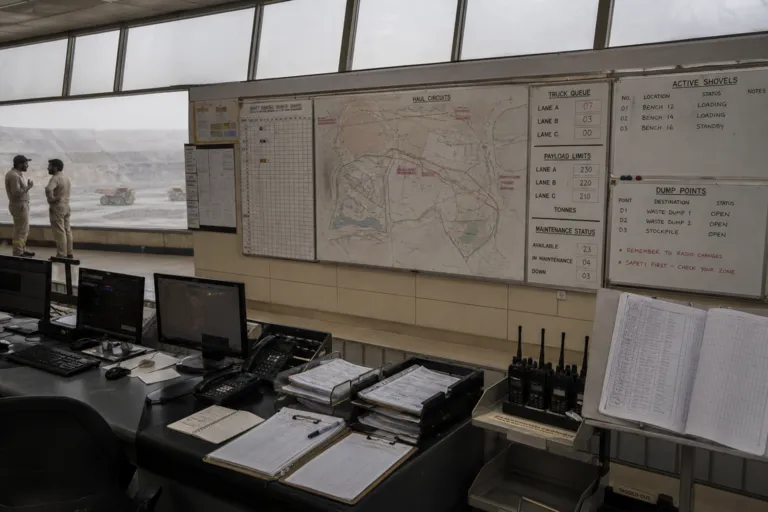
Mining-focused fleet management systems tie together location, operational status, and job assignment signals to coordinate trucks, loaders, and auxiliary equipment. Verified Market Research describes open-pit operations as environments where fleets must avoid congestion and downtime created by changing faces, weather impacts, and equipment availability, and where fleet systems support dispatch planning across shifting work cycles. Payload data tightens that loop. Spherical Insights explains that integrated payload telematics can continuously calculate TKPH or TMPH ratings per wheel position, and if an overloaded truck is dispatched on a high-speed haul cycle that exceeds safe thermal thresholds, the system can alter the haul route, throttle speed, or route the truck to a closer dump site. The same source states this approach can extend tire lifespan by up to 20% to 30%, which is a direct way to protect availability.
Vendors also connect payload and dispatch data to reconciliation and grade control. Spherical Insights notes that Komatsu’s DISPATCH Fleet Management System links payload numbers to material grade, tire heat, and shovel output, while Hexagon tools feed payload telemetry into 3-D mine models, block models, and ore-grade reconciliation systems so each ton can be followed from the muck pile to crushers, stockpiles, or waste dumps. For Saudi mine operators evaluating a mine fleet management system Saudi Arabia strategy, that linkage matters because it makes dispatch more than “send the next truck.” It becomes a control system for cycle time, queueing, and material tracking, using near real-time visibility enabled by telematics and GPS improvements described by Verified Market Research.
Powertrain change adds another layer to dispatch complexity, because energy and refueling constraints influence assignment and routes. Mordor Intelligence reports internal-combustion engines represented 87.71% of 2025 heavy-duty truck shipments in Saudi Arabia, while electrified powertrains (battery-electric, hybrid, and fuel-cell) are projected to grow at a 9.66% CAGR to 2031. A separate Saudi-focused hydrogen and electrification article says the NEOM project is expected to produce 600 tonnes of green hydrogen daily starting in 2027, described as equivalent to 1.2 million tonnes of green ammonia annually. That source also cites a Mining Technology feature stating electric mining trucks can cost from USD 50,000 to over USD 6 million depending on size and embedded technology, and that full-fleet electrification may not be commercially viable within the next decade due to implementation barriers. In practice, dispatch systems help operators run mixed fleets by matching the right truck to the right cycle while keeping utilization high.
How does dispatch software reduce idle time in open-pit mines?
What is the measurable benefit of payload telematics for tires?
What market signals support investment in fleet tools in Saudi Arabia?
How should Saudi mine operators think about a mine fleet management system in Saudi Arabia?
What do the sources say about hydrogen and electric trucks in Saudi mining contexts?