Sulfur is a strategic input because most supply is recovered as a co-product of petroleum refining desulfurisation and natural gas sweetening, not produced in response to downstream demand. One industry report frames Saudi Arabia as a major sulfur producer from Aramco oil and gas processing operations, while also describing Saudi Arabia as a growing sulfur consumer through Ma’aden phosphate fertilizer expansion programs. This makes the sulfur-to-acid chain a planning issue for fertilizer and industrial operators, rather than just a commodity procurement task. The same cyclical supply dynamic can tighten the elemental sulfur market when refinery operating rates decline, creating input-cost pressure for sulfuric acid producers that rely on purchased elemental sulfur.
The strongest local linkage is phosphate fertilizers. On 14 June 2023, Ma’aden announced a SAR 4.6 Billion expansion investment at the Waad Al Shamal Phosphate Complex in the northern Hejaz region of Saudi Arabia to increase annual diammonium phosphate (DAP) fertilizer production capacity by 1.5 Million metric tons. The source notes this increase requires a proportional increase in sulfuric acid. Ma’aden is described as operating integrated phosphate mining, beneficiation, sulfuric acid production, and fertilizer granulation operations, and it reported revenues of SAR 21.8 Billion for fiscal year 2022. In this context, the keyword topic—sulfur supply fertilizer Saudi Arabia—becomes concrete: incremental DAP output implies incremental acid, and incremental acid implies a reliable sulfur feedstock and logistics pathway.
Why Sulfuric Acid Connects Fertilizers to Metals Processing
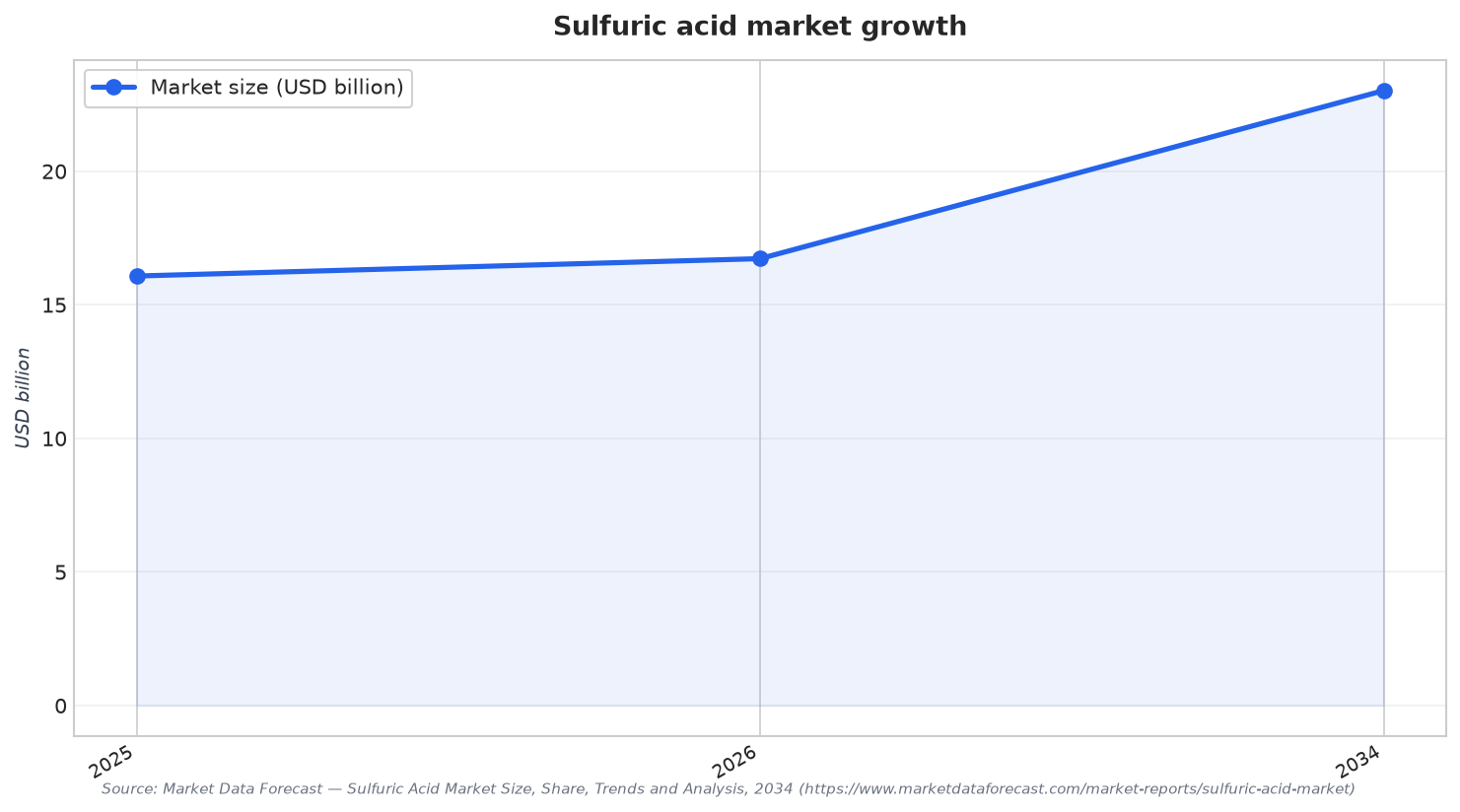
Globally, sulfuric acid demand provides the bridge between fertilizers and metals processing. One market forecast values the global sulfuric acid market at USD 16.08 billion in 2025, estimates USD 16.73 billion in 2026, and projects USD 23.02 billion by 2034, a CAGR of 4.07% from 2026 to 2034. The same source attributes growth to surging demand for phosphate fertilizers and the expansion of hydrometallurgical mineral processing for copper, nickel, cobalt, and lithium in clean energy supply chains. It also cites the U.S. Geological Survey statement that global sulfur production exceeded 85 million metric tons in 2023, with over 90% destined for sulfuric acid manufacturing. This reinforces that elemental sulfur access is a strategic advantage for any fertilizer complex that must keep acid plants running steadily.
Comparative figures show how large acid procurement can become at major phosphate hubs, while underlining that these are not Saudi numbers. An industry report notes the Mosaic Company’s US phosphate operations produced approximately 2.9 million tonnes of P2O5 in FY2025, and OCP Group consumed an estimated 11.3 million metric tonnes of acid in 2023. The same report places Ma’aden’s Saudi Arabia phosphate complex expansion alongside these examples to illustrate procurement scale, and it describes elemental sulfur as the dominant feedstock for purpose-built sulfuric acid plants at fertilizer complexes in North America, Morocco, Saudi Arabia, India, and China. It also describes the double absorption contact process producing 98% to 99.9% concentrated acid grades, highlighting why stable sulfur quality and uninterrupted operations matter for integrated fertilizer production.
Regional trade and investment signals add context for Saudi sulfur availability and standards. A solid sulfur report states the Middle East and Africa together account for 27% of global revenue share, attributing this share to large sour-gas and refinery complexes in Saudi Arabia, the United Arab Emirates, Qatar and Kuwait. In the U.S., another report says the country imported around 1.14 million metric tons of crude or unrefined sulfur in 2023, largely from Canada, the UAE, and Saudi Arabia, to meet fertilizer, chemical, and industrial needs. The same report notes a USD 7.7 billion EPC contract that Saudi Aramco signed in April 2024 for expanding the Fadhili Gas Plant, describing investment in sulfur recovery facilities to provide higher recovery rates and meet tougher environmental standards. Together, these points frame sulfur as a strategic input that links Saudi gas-processing recovery, domestic phosphate expansion, and sulfuric acid’s cross-sector pull from metals processing.
How does sulfur supply affect fertilizer production in Saudi Arabia?
What did Ma’aden announce for Waad Al Shamal, and why does it matter for sulfuric acid?
What is the global outlook for the sulfuric acid market?
How much of global sulfur production goes into sulfuric acid manufacturing?
What evidence shows Saudi sulfur is part of international supply chains?