The Saudi mining sector could become a major pillar of Vision 2030, with untapped mineral resources estimated at up to US$1.3 trillion and about US$32 billion of planned investment, according to the CEO Guide to KSA. Government financing and new rail links support growth, but investors must manage geological, financial and infrastructure risks.
Eurogroup Consulting's The CEO Guide to KSA: Saudi Arabia Reimagined, Are You Ready?, published in March 2024, identifies mining as an emerging industry under Vision 2030 and highlights the government mechanisms intended to encourage investment.
How Big Is the Saudi Mining Sector's Potential?
Saudi Arabia's economy has historically been associated with hydrocarbon production, but Vision 2030 seeks to develop additional industries that can support economic diversification. Mining is among the sectors identified for expansion.
According to the CEO Guide, Saudi Arabia's untapped mineral resources were estimated at up to US$1.3 trillion during the research period. This figure refers to the estimated value of mineral resources, not verified commercially recoverable reserves or expected investment returns. The guide also highlights approximately US$32 billion in planned investment intended to support mining-sector development.
Foreign investment in the sector remained comparatively modest at the time. The guide's 2022 FDI analysis shows mining and quarrying at approximately SAR 23.9 billion of FDI stock, compared with SAR 238.8 billion for manufacturing.
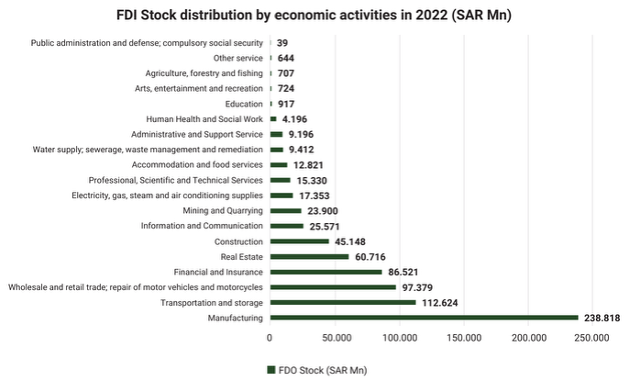
Figure 1: FDI Stock Distribution by Economic Activities in 2022 (SAR Mn). Source: The CEO Guide to KSA, Eurogroup Consulting (p. 28).
However, mineral-resource potential does not automatically translate into profitable production. Commercial development requires geological assessment, exploration expenditure, suitable extraction methods, processing capabilities, and access to infrastructure. Individual projects must demonstrate technical feasibility and economically recoverable deposits. For suppliers, the mining sector can also create demand beyond extraction itself, including equipment, engineering services, environmental systems, and industrial technologies.
From Exploration to Industrial Development
Mining investment encompasses several stages, each involving different technical and commercial requirements. Exploration companies must identify deposits and evaluate geological characteristics before assessing development feasibility. Mine development requires capital-intensive infrastructure, specialized equipment, and skilled personnel, while processing adds requirements concerning energy supply, technology, logistics, and environmental management.
A drilling technology provider may enter the market through equipment supply or specialist services, while a mineral-processing company could require a substantially different investment structure. Mining development can also support industries that require reliable mineral inputs, including construction materials and manufacturing.
The Saudi Industrial Development Fund (SIDF) is among the institutions identified in the CEO Guide as providing financing support for strategic sectors, including mining. Such mechanisms can assist eligible projects, but companies must evaluate financing conditions, project readiness, and applicable requirements individually.
For investors, the commercial question is not simply whether Saudi Arabia has significant mineral resources, but which projects can convert those resources into sustainable industrial activity.
How Does Infrastructure Support Mining Growth?
Mining projects frequently operate in locations distant from established industrial centers. Transport connections, electricity, water, and communications affect both development costs and ongoing operations.
The CEO Guide identifies Saudi Arabia's North-South Railway as an important example of infrastructure supporting the mining industry. The railway connects mineral-producing areas in northern Saudi Arabia with processing and export facilities.
However, railway access alone does not guarantee project viability. Mining operations may require additional road connections, specialized handling facilities, water infrastructure, and reliable power supplies, particularly in remote regions. Read more about this challenge in Water, Power, and Roads First: How Saudi Arabia's Mining Infrastructure Enablement Initiative De-risks Remote Deposits.
Financing is equally important because exploration and mine development can involve substantial upfront expenditure before commercial production begins.
What Should New Entrants Consider?
Julien Pescheux, former Executive Vice President of Saudi Airlines Catering Company, offers this assessment in the guide:
"Mining in Saudi is one of the areas that I would pay particular attention to"
However, investors should distinguish strategic ambitions from commercial readiness. Geological uncertainty can affect exploration outcomes, while project economics may depend on mineral prices, recovery rates, infrastructure costs, and processing requirements. International investment can bring specialized exploration, engineering, and processing expertise, but effective implementation may require cooperation with local partners and institutions. Mining activities may also require substantial water and energy resources, alongside appropriate waste management and environmental controls.
Key investment considerations include:
- Geological feasibility: Assess resource quality, recoverability, and exploration uncertainty.
- Infrastructure readiness: Evaluate access to transport, electricity, water, and processing facilities.
- Financial viability: Consider capital requirements, operating costs, and mineral-price exposure.
- Regulatory compliance: Understand licensing, environmental obligations, and applicable investment requirements.
- Commercial partnerships: Identify suitable technical, financial, and local operating partners.
The CEO Guide to KSA places mining within Saudi Arabia's wider investment environment, including industrial incentives, logistics infrastructure, and market-entry considerations. The long-term opportunity lies in developing commercially sustainable operations rather than relying solely on headline estimates of resource value.
For tailored support, explore our mining market entry strategy or contact our team to discuss your requirements.
Frequently Asked Questions
How valuable are Saudi Arabia's mineral resources?
According to Eurogroup Consulting's CEO Guide to KSA, Saudi Arabia's untapped mineral resources were estimated at up to US$1.3 trillion during the research period, supported by about US$32 billion of planned investment. This represents resource potential rather than commercially recoverable reserves, so individual projects still require geological studies and feasibility assessments.
Why is mining important to Saudi Vision 2030?
Mining is a key diversification pillar of Vision 2030 because it reduces dependence on hydrocarbons and supplies raw materials for industrial and export growth. The sector can support processing, manufacturing, construction materials and employment, while creating demand for engineering, equipment, infrastructure and specialist services linked to exploration and extraction.
What financing is available for mining investors in Saudi Arabia?
The CEO Guide identifies the Saudi Industrial Development Fund (SIDF) as a key source of financing for strategic sectors, including mining, logistics and energy. SIDF offers loans to eligible projects to support infrastructure and productive capacity. Investors should verify current program availability, eligibility criteria, repayment conditions and the financial feasibility of each development.
How does the North-South Railway support Saudi mining?
The North-South Railway connects mineral-producing areas in northern Saudi Arabia with processing and export facilities on the Gulf, helping move bulk materials efficiently. The CEO Guide presents it as an example of transport infrastructure supporting mining. Individual projects may still need additional roads, water, power and handling facilities, especially in remote areas.
What risks should foreign mining companies consider?
Key risks include geological uncertainty, high capital requirements, mineral-price exposure, infrastructure gaps, regulatory and licensing obligations, and environmental management, particularly water and energy use. Companies should evaluate technical feasibility, project economics, available partners and talent before committing investment, because strong resource potential does not remove the need for project-specific due diligence.
Explore Saudi Arabia's Mining Investment Potential
For business leaders assessing this emerging sector, Eurogroup Consulting's CEO Guide provides broader insight into the Kingdom's economic diversification, investment environment, infrastructure priorities, and market-entry strategies.