In Saudi open-pit operations, fragmentation is not just a blasting outcome. It is a cost driver that reaches loading, hauling, crushing, and grinding. Research on open-pit blasting stresses that predicting mean fragmentation size (MFS) is crucial to avoid increased production costs, material loss, and ore dilution. The same work also notes that blast-induced fragmentation is a core indicator of blast quality, and that rock strength can dominate outcomes: unconfined compressive strength (UCS) emerged as the most influential parameter affecting MFS prediction in a hybrid intelligent model. For teams targeting blast fragmentation optimization in Saudi mining, the message is simple. You need reliable fragmentation targets, and you need site-calibrated ways to predict when a design will miss those targets.
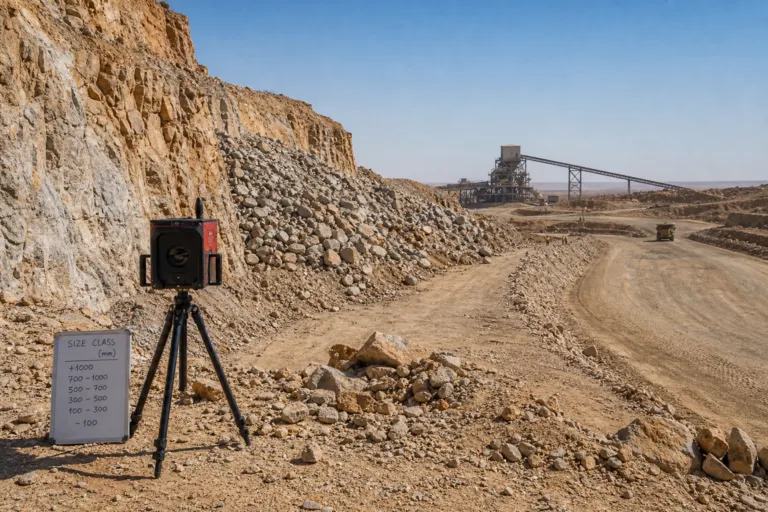
Measurement is the bridge between plans and reality. In operating open pits, fragmentation is typically expressed as a particle size distribution (PSD) curve showing percentage passing versus rock size. AMC Consultants notes that quantifying fragmentation helps confirm the rock mass is broken enough to load, and that oversize does not exceed the crusher open size. They also highlight an economic nuance: improved and consistent fragmentation across a blast profile generally supports higher extraction rates and therefore lower loading costs, while drill and blast costs may be reduced when results are finer than required. Modern measurement options include optical imaging and laser scanning with proprietary algorithms, used either ad hoc with a portable camera at the face or continuously with cameras mounted on shovel arms or excavator booms, with positional records to match results to blast zones.
From Mine to Crusher: Optimize for the Whole Cost Chain
Fragmentation optimization works best when it is framed as mine-to-crusher decision-making, not a narrow drill-and-blast exercise. One mine-to-crusher optimization study describes blasting-pattern optimization as strategic adjustment of blast design parameters to achieve optimal fragmentation while minimizing operational costs and mitigating impacts such as fly-rock and back-break. In that research, a cost predictive system was introduced to calculate operating costs from drilling to crushing, explicitly including fragmentation effects on loading, hauling, secondary blasting, and crushing. The authors warn that their dataset came from a single large-scale open-pit mine under site-specific geological and operational conditions, so direct transferability requires local recalibration. That caution matters for Saudi Arabia: models and “best practices” should be treated as a starting point, then tuned to local geology, benches, and equipment limits.
Control and compliance are the other half of the equation. A workflow on drilling and blasting design noncompliance explains that blasts are designed to balance drill-and-blast costs with downstream costs in loading, hauling, crushing, and grinding. It also notes that, during the rush of production, design compliance is often overlooked or not tracked, which helps explain why some blasts produce highly variable fragmentation outcomes. The workflow is positioned as flexible: practitioners can use their own costing functions to quantify economic impact rather than rely on rigid variables that may not fit a given operation. For Saudi open pits, this supports a practical governance approach: define what “compliance” means on your benches, track it routinely, and connect deviations to measured PSD outcomes and downstream rehandling, oversize, and crusher constraints.
Automation and analytics can tighten the loop between geology, design, and results, but they still need local validation. A drilling and blasting automation market report states that automated systems can calculate optimal hole spacing, powder factor, and charge configuration based on geological parameters and market commodity prices. It also claims improved fragmentation reduces downstream processing costs by 15% to 25%, and that advanced analytics can reduce material waste by 20% to 30% while improving fragmentation patterns. These figures are presented as general industry impacts, not Saudi-specific results, so they should be used as context. Still, combined with field measurement, cost modeling from drilling to crushing, and disciplined compliance tracking, they outline a realistic roadmap for blast fragmentation optimization in Saudi mining focused on repeatability, safety outcomes like fly-rock, and stable plant feed.
Why does fragmentation quality affect costs beyond drilling and blasting?
How is blast fragmentation measured in an operating open pit?
What variables can strongly influence mean fragmentation size (MFS)?
What is the risk of applying a fragmentation optimization model from another mine to Saudi operations?
How can blast fragmentation optimization in Saudi mining use automation responsibly?