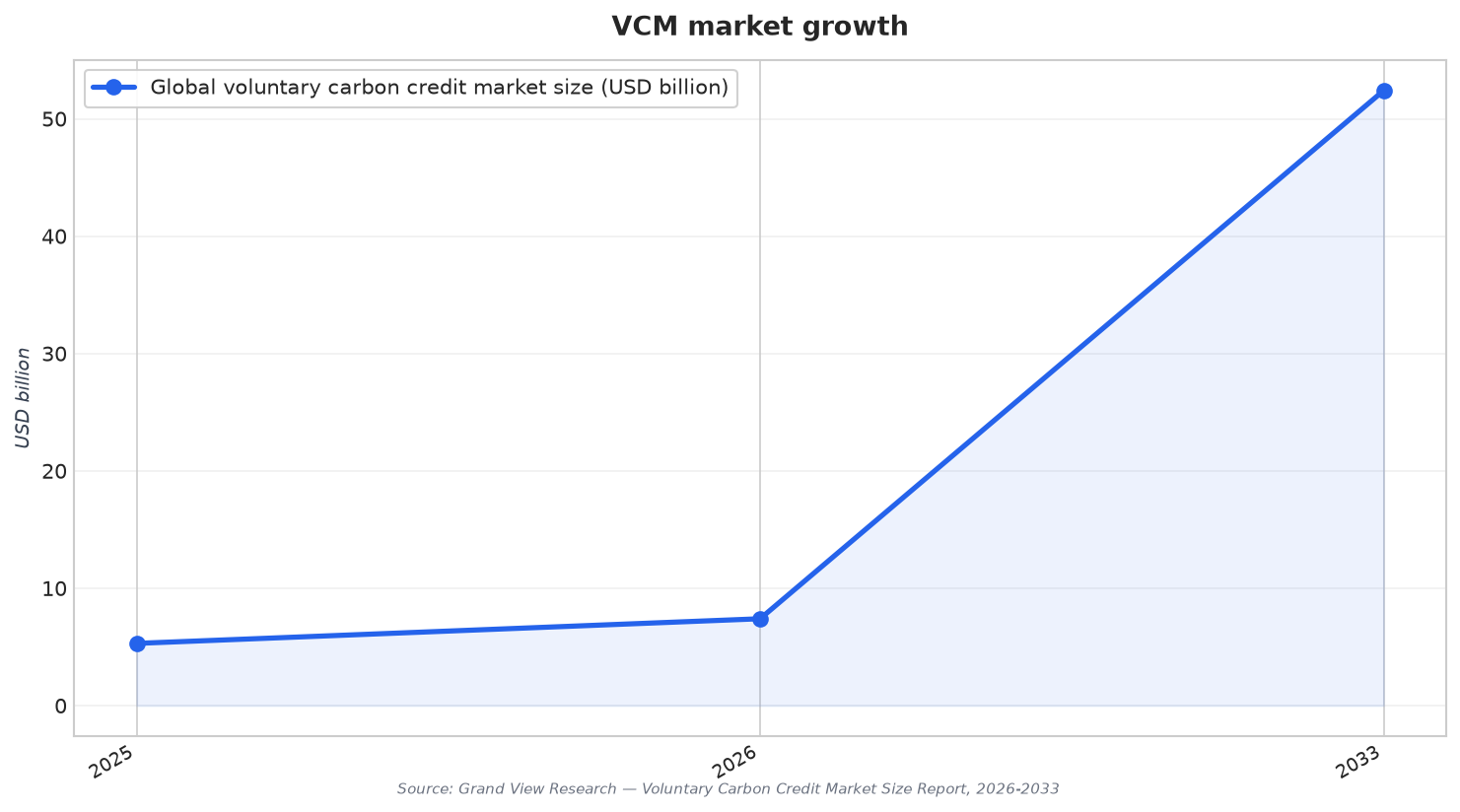
For project developers, the core question is practical: can a Saudi mine turn measurable emissions reductions into cash by selling verified credits. The voluntary carbon market is built for discretionary action, where businesses and other buyers purchase credits from projects that reduce or remove greenhouse gases. In global context, estimates differ by source, but both point to rapid growth. Polaris Market Research values the global voluntary carbon credit market at USD 3,024.52 million in 2025 and projects a 25.6% CAGR from 2026 to 2034. Grand View Research estimates USD 5.3 billion in 2025, with a rise to USD 7.4 billion in 2026 and USD 52.4 billion by 2033 at a 32.2% CAGR.
Saudi Arabia’s local readiness is not only about demand. It is also about market infrastructure and policy framing. A Saudi-led initiative launched the Regional Voluntary Carbon Market (RVCM) at COP27, described as the first carbon credit trading platform for the Middle East and North Africa. The same guide links the opportunity to Saudi corporate demand for offsets tied to sustainability commitments and reporting, and it names Saudi Aramco, SABIC, and Ma’aden among major industrial companies with emissions reduction targets. That matters to miners because heavy industry is already a major use case in carbon markets. In Grand View Research’s global voluntary market segmentation, the industrial application held a 32.2% market share in 2025.
What Miners Must Prove: MRV, Quality, and the “Right” Credit Type
Monetization depends on whether credits are trusted, not only produced. The Saudi guide highlights MRV and verification services as a specific opportunity area, because measurement, reporting, and verification underpin both project issuance and corporate accounting. Global market splits also show why quality drives outcomes. Analysis Atlas reports a REDD+ avoidance credit traded around $2.70 a tonne in 2025, while a tonne removed by direct air capture ran roughly $500 to $1,000, based on pricing tracked by CDR.fyi. It also notes enhanced rock weathering showed a split in January 2025: suppliers wanted about $349 a tonne and buyers accepted about $271. For mining projects, these spreads emphasize that “emission cuts” are not priced equally across methodologies.
Miners should also plan for scrutiny and shifting buyer preferences. Analysis Atlas describes how a January 18, 2023 joint investigation by The Guardian, Die Zeit, and SourceMaterial reported that most rainforest-protection credits issued by Verra—then the certifier of roughly three-quarters of all voluntary offsets—looked like “phantom credits.” The same source says Shell, Nestle, EasyJet, and the miner Fortescue all stepped back from voluntary offset programs. That history raises the bar for project design, documentation, and monitoring. It also aligns with research that market attention is moving toward removals, with Grand View Research expecting removal credits to account for 35% of the market by 2030.
For Saudi operators, the regional market backdrop suggests growing relevance even beyond the voluntary segment. Grand View Research estimates the Middle East carbon credit market at approximately USD 4.72 billion in 2024 and projects USD 31.28 billion by 2033 at a 19.9% CAGR from 2025 to 2033. It also states Saudi Arabia held the largest share of this Middle East market at 38.56% in 2024, while compliance credits held 93.41% of the market that year. For carbon credits mining Saudi Arabia strategies, the signal is clear: voluntary monetization can fit alongside a region where compliance mechanisms dominate today, so miners should build projects with strong verification and flexibility to meet different buyer requirements.
Can Saudi mining projects sell carbon credits through voluntary markets?
What makes a mining-related carbon credit credible to buyers?
How do carbon credit prices differ between avoidance and removals?
How large is the voluntary carbon market globally, according to the sources?
What does the Middle East carbon credit market data suggest for Saudi Arabia?