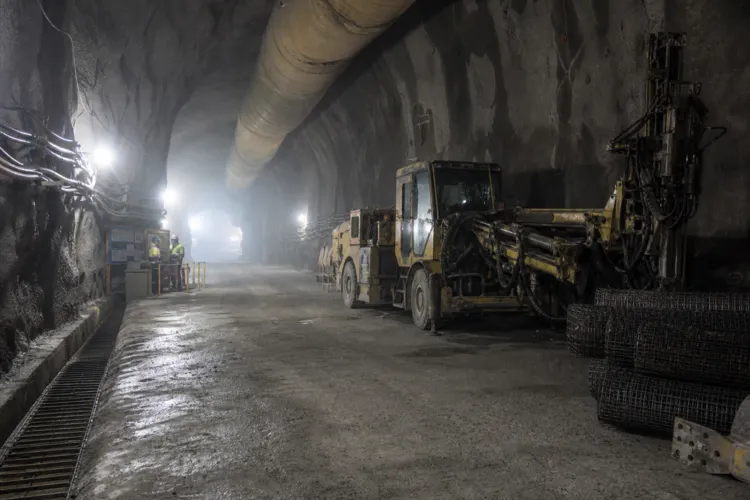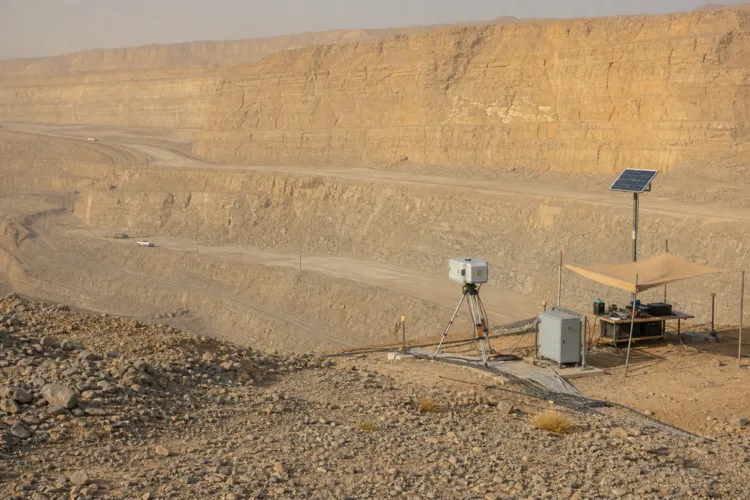
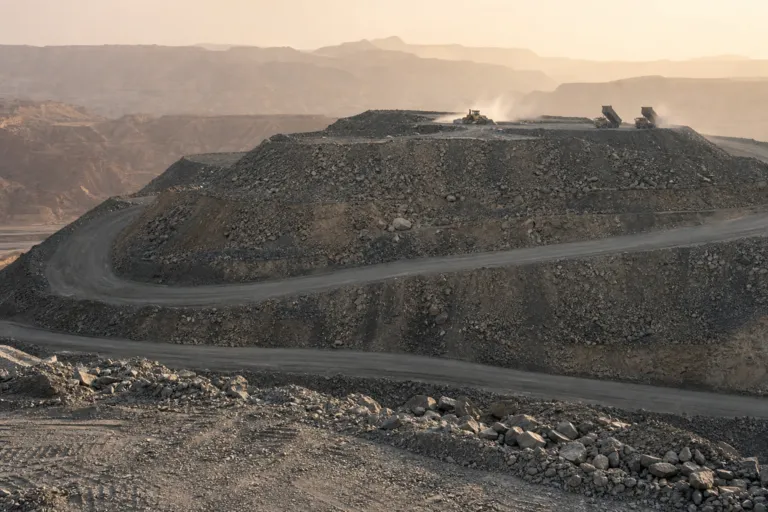
Waste rock dumps are engineered landforms. Their footprint, stability, and long-term water interaction can shape environmental outcomes for decades. A key risk to design around is acid mine drainage (AMD), which can form when sulphidic minerals in waste rock and tailings oxidise in the presence of air and water and generate sulphuric acid and dissolved metals, including iron, zinc, copper, and arsenic. That is why responsible dump design is not only about stacking and slopes. It is also about separating materials by geochemical behaviour, limiting water contact, and planning closure from the start so liabilities do not persist as “the most persistent and geographically widespread environmental liability in the global mining industry.”
Circular-economy thinking creates a second design driver: future reuse. A mining waste classification review separates potential beneficial uses by grain size. Coarse-grained material can substitute for aggregate, while fine-grained material may substitute for sand or bulk minerals. The same review notes that waste rock and other coarse material should be evaluated for potential reuse using criteria applicable to aggregate. It also stresses that undergrade ore stockpiles may wait for future beneficiation, but they must be managed separately if they have AMD potential or other properties that make them unsuitable for safe disposal or direct reuse. In practice, that pushes mines toward “designing for sorting,” not only for dumping.
Designing Dumps for Compliance and Reuse in Saudi Arabia
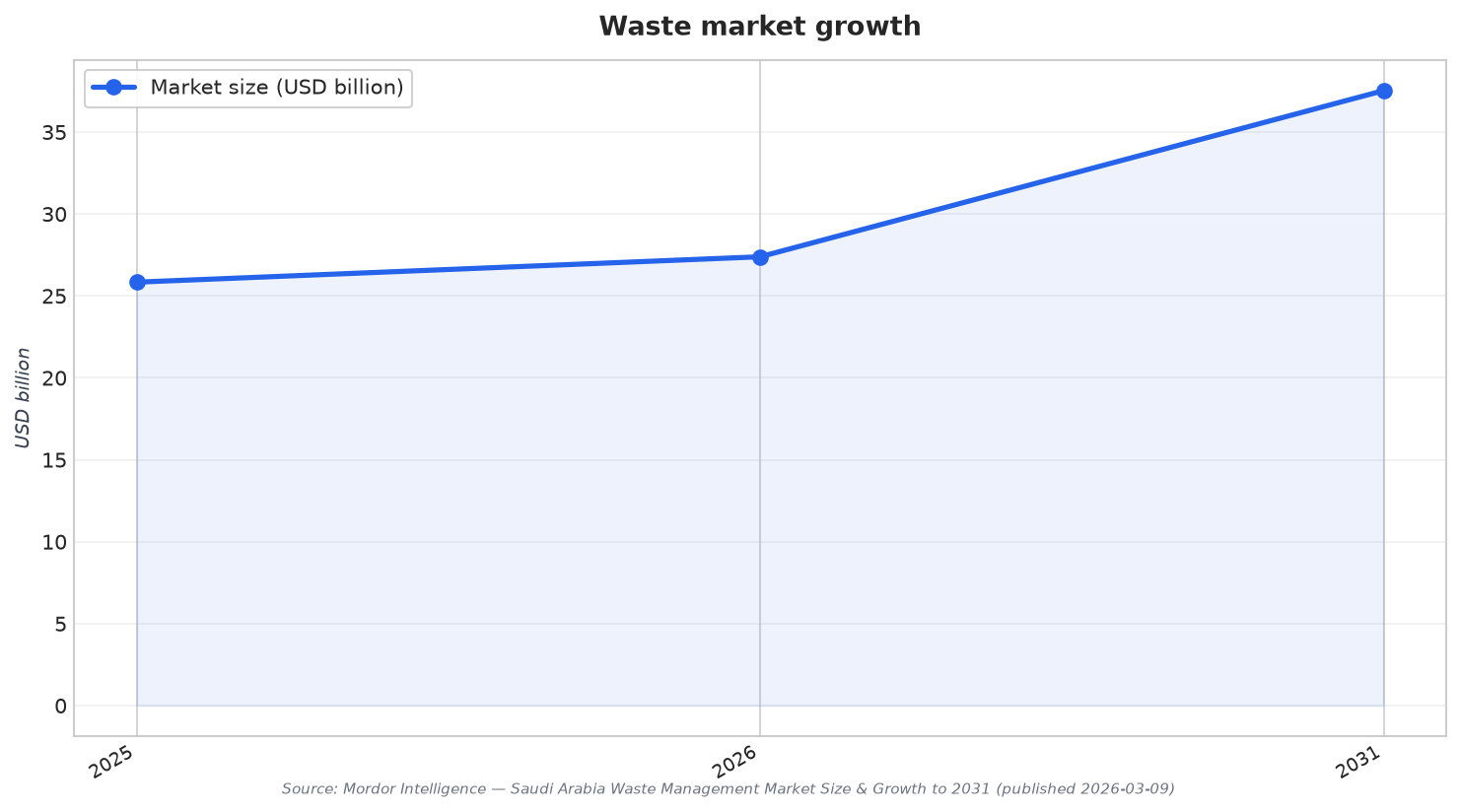
In Saudi Arabia, broader waste policy and service capacity set the direction of travel for waste rock management Saudi Arabia mining teams must execute on-site. Mordor Intelligence valued the Saudi Arabia waste management market at USD 25.84 billion in 2025 and estimates growth from USD 27.39 billion in 2026 to USD 37.53 billion by 2031, at a 6.5% CAGR (2026–2031). The same source links the transition away from uncontrolled landfilling to Vision 2030 pressure and stricter penalties under Royal Decree M/3, including fines up to USD 8 million and prison terms for non-compliance. It also describes technical guidelines released in 2024 that require on-site segregation for projects larger than 10,000 square meters, reinforcing the value of traceable, segregated material streams.
Mining does not sit alone inside this ecosystem. Construction programs such as NEOM and the Red Sea Project are cited as drivers of construction-and-demolition (C&D) waste and demand for mobile crushers, material recovery facilities, and refuse-derived-fuel plants. Saudi Investment Recycling Company (SIRC) alone recycled 16 million tons of C&D waste in 2025, while SIRC, Veolia, SUEZ, Averda, and BEEAH collectively managed more than 50% of treated volumes that year. Separately, Mordor Intelligence expects the Saudi Arabia C&D waste management market to increase from USD 0.81 billion in 2025 to USD 0.86 billion in 2026 and reach USD 1.16 billion by 2031 (6.21% CAGR over 2026–2031). For mines, these signals matter because they suggest a scaling service base for crushing, screening, and verified diversion pathways that can support suitable coarse material reuse.
Operationally, moving and reshaping waste rock depends on heavy transport. A Research and Markets press release hosted by Yahoo Finance values the Saudi Arabia dump trucks market at USD 1.6 billion, describing growth tied to construction and mining activity and highlighting opportunities in energy-efficient and electric dump trucks. This matters for dump design because haulage capacity is a real constraint on how selectively you can place material, build separate cells, or rehandle rock for later use. Finally, the “zero waste mining” push is becoming a tracked market in-country. Grand View Research states the Saudi Arabia zero waste mining market generated USD 79.9 million in 2025 and is expected to reach USD 191.5 million by 2033 (11.67% CAGR from 2026 to 2033), with tailings management technologies the largest revenue generating technology in 2025 and a 33.92% revenue share. Even when the focus is tailings, the same discipline of classification, segregation, and engineered containment strengthens waste rock outcomes.
Why is waste rock dump design closely linked to acid mine drainage risk?
What reuse pathway is most commonly discussed for coarse mining waste?
How do Saudi Arabia’s waste market signals affect waste rock management in mining?
What evidence is there that recycling and processing capacity is scaling in Saudi Arabia?
What is the projected growth outlook for Saudi Arabia’s zero waste mining market?