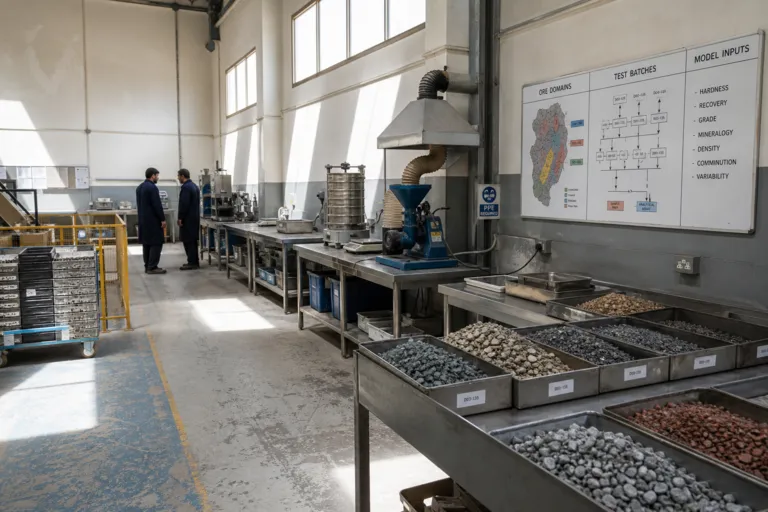
Ore bodies are not uniform. Deposits vary in grade, mineralogy, texture, hardness, and metallurgical response across space. Traditional processing design often treated this variability as noise by testing a composite sample, measuring a single set of parameters, and designing to the average. The sources describe consequences seen at mine sites around the world: throughput shortfalls, unexpected recovery losses, concentrate quality failures, and capital cost overruns. In that context, the goal for geometallurgy in Saudi mining is practical. It is about building predictability by planning for the distribution of ores the plant will actually process, not the “average” ore.
Geometallurgy combines geological understanding with metallurgical test work and/or real-time processing plant data to create a geology-based three-dimensional predictive model of mineral processing response. It is used in hard rock mining for risk management and mitigation during mineral processing plant design. It is also used for production mine planning to optimize ore feed to the processing plant. A common structure described in the sources uses four components. First is geologically informed selection of ore samples. Second is laboratory-scale test work to determine response to unit operations. Third is distributing those parameters through the orebody using accepted geostatistical techniques. Fourth is applying a mining sequence plan and mineral processing models to predict plant behavior.
From Variability Sampling to a Predictive Orebody Model
Sample strategy is a major practical lever because mass requirements depend on the mathematical plant model and the tests needed to supply its parameters. The sources note that flotation testing usually requires several kilograms of sample, while grinding and hardness testing can require between 2 and 300 kilograms. Samples are usually core samples composited over the height of the mining bench. Because additional test work can have diminishing returns, programs often seek secondary correlations to improve precision without extra sampling and testing cost. These correlations can use multivariable regression with non-metallurgical ore parameters and/or domaining by rock type, lithology, alteration, mineralogy, or structural domains.
Test work typically splits into comminution behavior and recovery behavior. For comminution parameters linked to crushing, grinding, and associated energy use, the sources list common tests such as the Bond ball mill work index test, Bond rod mill work index, SAGDesign, SMC, JK drop-weight, point load index, and SAG Power Index (SPI®). Once parameters exist, they must be modeled spatially. Block kriging is described as a common approach, but the sources also warn that many geometallurgical properties are non-additive, making traditional kriging less ideal for representing them accurately. Alternative approaches such as sequential Gaussian simulation are presented as better at capturing variability and spatial uncertainty for non-additive properties.
Turning predictions into reliable operating decisions also requires disciplined data handling across the mine-to-mill chain. One source frames a persistent integration problem: estimates are transferred from samples to blocks, blocks to parcels, parcels to plant feed, and then plant data back to geological interpretation, often without explicitly tracking where each estimate is valid or how uncertainty changes. A support-aware Bayesian framework is proposed as an architecture for auditable uncertainty transfer, reconciliation, value-of-information analysis, and geometallurgical digital twins. For short-term planning, integrating geometallurgical properties into block sequencing is described as significantly improving operational decision-making, resource efficiency, and financial performance. Ore performance variables can include recovery, flotation concentrate yield, ore hardness, throughput, tailings yield, and water and energy consumption.
What is geometallurgy, in simple operational terms?
What are the four core steps in a geometallurgical program?
How much sample is typically needed for common geometallurgical tests?
Why can non-additive geometallurgical properties be difficult to model with kriging?
How does geometallurgy support Saudi mining teams trying to make plant performance more predictable?