Mining tenure in Saudi Arabia is governed by the Mining Investment Law, which the U.S. Geological Survey notes was approved in June 2020, became effective in January 2021, and replaced the 2004 Mining Investment Law. The framework is overseen by the Deputy Ministry of Mineral Resources within the Ministry of Industry and Mineral Resources, which oversees mining activities, promotes investments, provides services, and issues mining licenses and concessions. In practice, keeping a licence active is not only an administrative task. It is also tied to ongoing compliance and to using official channels when a holder needs renewal, changes to scope, or an exit from all or part of a licensed area.
For day-to-day licensing actions, the Ta’adeen platform describes a set of regulated services for reconnaissance, exploration, exploitation, and general purpose licences, aligned with legal, environmental, and technical standards. It states that exploration licences are valid for up to five years with renewal options. It also notes that exploitation licence duration depends on the mineral class and the nature of operations. Across both exploration and exploitation, licence holders must adhere to environmental, social, safety, and financial commitments. Those commitments are the practical “work commitments” that sit behind tenure security, because the system is designed around compliant performance, not passive holding.
Renewal, Amendments, Transfers, and Compliance Monitoring
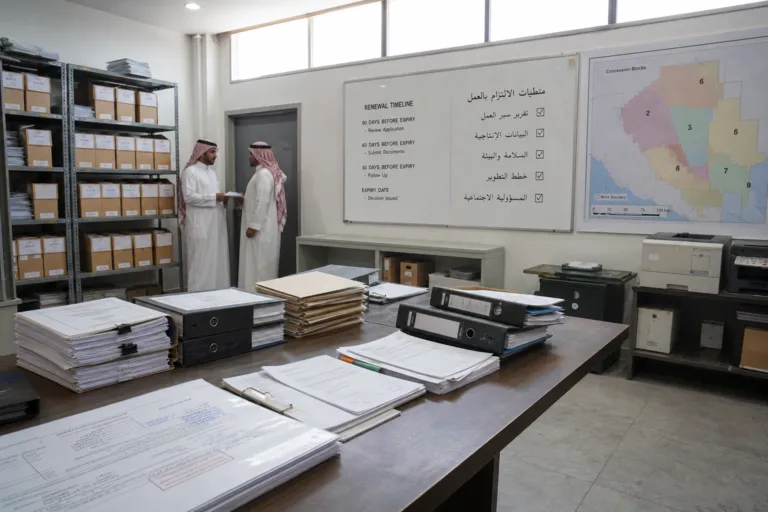
Renewal is only one part of staying in good standing. Ta’adeen frames renewal as an application-based service, and it also lists related pathways that matter when project needs change. These include amending a licence to amend the minerals or increase the licence area, and transferring an exploration or exploitation licence to another eligible investor. The Mining Investment Law regime also has an enforcement posture. A CMS legal overview says the Ministry of Industry and Mineral Resources may enter a “licence site” to inspect, monitor, and control licence violations to ensure compliance with the law, and that the violations and penalties regime is more comprehensive than under the 2004 law, with a maximum fine of up to SR 1 million for each violation.
Relinquishment is a formal, structured option when a holder needs to discontinue operations or reshape its footprint. On the Ministry of Industry and Mineral Resources website, the License Relinquishment Service is described as enabling an investor to relinquish all or part of a licensed area, along with the rights and obligations associated with conducting mining activities. The service requires submitting an application and providing the reasons for the relinquishment. The stated purpose is to allow investors to relinquish their mining license, in whole or in part, for any reason that requires them to discontinue their mining operations. This makes relinquishment a governed process, not an informal surrender.
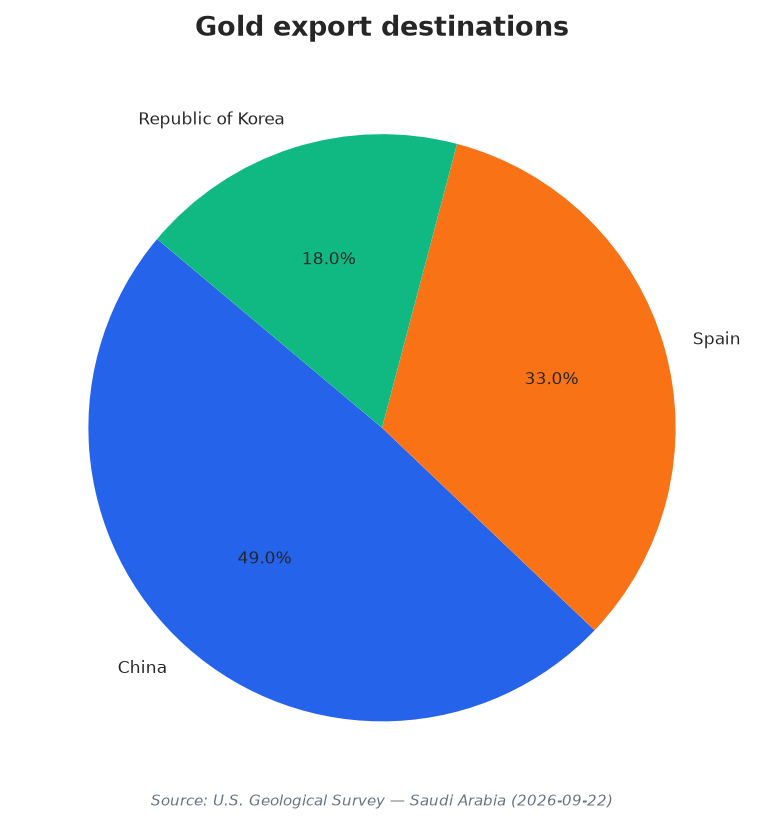
For investors thinking about mining license renewal and relinquishment in Saudi Arabia, it also helps to keep the broader sector context in mind, because policy attention and enforcement capacity tend to track economic relevance and activity. The U.S. Geological Survey reports that in 2024, mining and quarrying contributed 0.4% to Saudi Arabia’s gross domestic product, while crude petroleum and natural gas contributed 19% and manufacturing contributed 7.3%. It also reports operational and trade signals, including mined gold output increasing by 21% to 16,293 kilograms in 2024 compared with 2023, and zinc concentrate exports increasing by 73% to 102,000 metric tons in 2024 compared with 2023, with major destinations of China (49%), Spain (33%), and the Republic of Korea (18%).
How long is an exploration licence valid in Saudi Arabia, and can it be renewed?
What does a licence holder have to keep doing to stay compliant?
How does mining license renewal and relinquishment work in Saudi Arabia?
Can you relinquish only part of a licensed area?
What penalties can apply for violations under the Mining Investment Law framework?