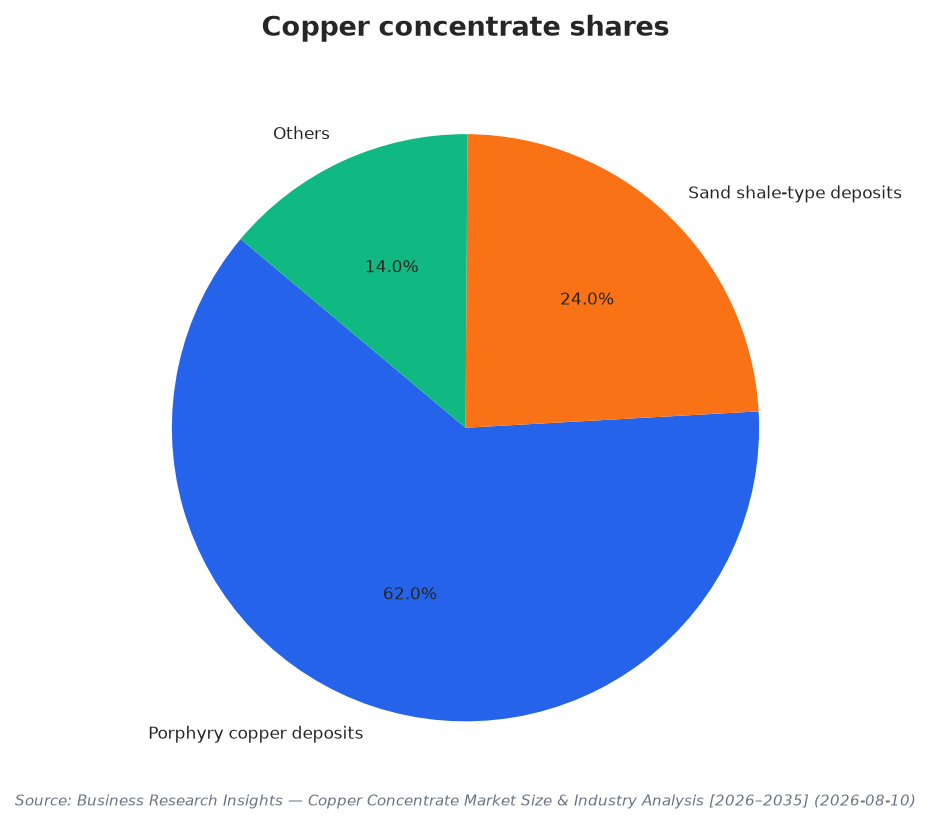
Hunting for large copper systems often starts with one simple reality: most of the world’s copper project attention is already clustered around porphyry-style geology. One industry report states that 71% of global copper mining projects are concentrated around porphyry ore systems, citing consistent ore grades and long operational lifespans. The same report also says porphyry copper deposits account for about 63% of copper concentrate market share, and that 41% of exploration projects focus on porphyry copper deposits with high-grade mineral reserves. Against that global backdrop, the question becomes whether the Arabian Shield can host the same kind of system-scale opportunity that tends to attract sustained exploration budgets.
The geological rationale exists inside the broader Arabian-Nubian Shield, which is described as a Precambrian-age formation estimated at approximately 900 million years old. In Egypt’s Eastern Desert and Sinai regions within this shield, sources describe hydrothermal alteration zones associated with porphyry copper-molybdenum deposits, alongside mineral diversity that includes gold, copper, molybdenum, tungsten, rare earth elements, and phosphates. The same Egypt-focused source cites copper resource estimates ranging from 2–4 million tonnes of copper metal equivalent in various mineralization zones. It also links consistent copper-molybdenum mineralization patterns to systematic geological controls across defined exploration blocks, a detail that matters because porphyry hunting is often about repeatable controls, not one-off anomalies.
Why the Saudi Arabian Shield Still Looks Like an Exploration Puzzle
In Saudi Arabia, published geological work helps narrow where porphyry signatures may cluster. A US Geological Survey study referenced in a Saudi Geological Survey explainer describes the Ar Rayn terrane as a continental-margin arc with volcanic and plutonic rocks from about 689 to 583 million years old. That same description notes that epithermal, porphyry copper, and iron-oxide copper-gold (IOCG) systems are concentrated along the Al Amar fault, interpreted as a major intra-arc fault rather than an ophiolitic suture. The explainer also emphasizes that Saudi Geological Survey maps, mineral occurrence records, and survey data are the starting point for licence applications, bid-round evaluations, and investment screening, with the Kingdom’s exploration history outlined in phases spanning 1934–1963, 1963–1998, and 1999 onward.
That data foundation is now paired with licensing momentum. A 2026 licensing update says 24 companies qualify in 2026, and it cites an estimated combined resource valuation of SR9.4 trillion (approximately USD $2.5 trillion) across mineralised systems carrying gold, silver, copper, nickel, and zinc. The same source adds that Arabian Shield geochemical survey data has strengthened confidence in prospectivity, supporting the valuation estimate. For explorers targeting porphyry copper in the Arabian Shield, this mix of public datasets and formal licensing pathways can reduce early-stage uncertainty. It also helps teams prioritize structural corridors and belt-scale targets before committing to heavier field programs.
Modern targeting methods also shape how quickly a frontier thesis can be tested. One industry report states automated drilling and ore processing technologies are utilized in 58% of porphyry mining facilities globally, and that around 37% of mining companies invest in AI-driven geological analysis and predictive maintenance systems to improve operational productivity. A separate porphyry innovation overview describes AI-driven geospatial analysis as a tool that automates large-scale mineral targeting, supporting global expansion. In practice, that means the porphyry copper Arabian Shield story is not only about rocks and structures. It is also about whether explorers can integrate survey datasets, satellite screening, and fault-focused models to identify a system-scale target fast enough to justify the next stage of drilling.
Why do companies focus so heavily on porphyry copper systems?
What evidence links Saudi Arabia’s Shield geology to porphyry potential?
How big is the resource valuation cited for Saudi mineralised belts?
What copper resource range is cited in the Arabian-Nubian Shield context in Egypt?
How does technology affect porphyry copper exploration and operations?