Saudi Arabia is evaluating a step-change: moving from bulk phosphate chemistry into ultra-high-purity inputs for batteries. An IndexBox 2026 analysis describes the local battery-grade phosphoric acid and phosphates segment as nascent and still in pilot-scale production, with customer qualification and planning for dedicated facilities. The same analysis frames the opportunity as tied to Vision 2030 and downstream industrial diversification, linking the Kingdom’s established mineral and chemical industries with emerging ambitions in electric vehicle and battery manufacturing. The core logic is value capture: strict purity and consistency requirements make battery-grade material technically harder than fertilizer or technical grades, but also a higher-value niche that can connect Saudi producers to advanced global supply chains.
Global demand signals help explain why purified phosphoric acid in Saudi Arabia is being discussed as more than a fertilizer story. Kings Research values the global phosphoric acid market at USD 47.28 billion in 2025 and projects USD 65.67 billion by 2033, with a 4.23% CAGR. It also says the electronics and semiconductor segment is the fastest-growing end use, with an anticipated 4.91% CAGR during the forecast period. On the battery side, the same source states LFP batteries supply about 40% of the global EV battery market, and in battery storage LFP accounts for around 90% of new installations. It adds that 108 GW of new battery storage capacity was deployed worldwide in 2025, which was 40% more than in 2024. These figures describe global momentum, not Saudi-specific outcomes, but they set the demand context for high-purity materials.
Why Battery-Grade Purity Changes the Industrial Playbook
Battery-grade phosphoric acid is defined by its role in LFP cathode chemistry and by the tight quality window required by customers. IndexBox notes that battery-grade phosphoric acid is used as a precursor for iron phosphate (FePO4) and ultimately lithium iron phosphate (LiFePO4), and stresses the need for rigorous certification protocols recognized by global OEMs. Straits Research echoes that battery-grade phosphoric acid is an ultra-pure intermediate refined to meet stringent purity standards for LFP cathode materials. It sizes the global battery-grade phosphoric acid market at USD 1.00 million in 2025, projecting USD 2.01 million by 2034, and notes Asia Pacific held 67.38% share in 2025. It also reports liquid form at 64.25% share in 2025 and electric vehicles at 58.40% share by end-use in 2025. These statistics are global and highlight where scale and competition already exist.
For Saudi Arabia, the strategic question is how to translate upstream strength into a differentiated purified offering while staying cost-competitive with established producers. IndexBox states growth will be non-linear and heavily influenced by the pace of downstream investments in cathode active material production and battery cell gigafactories within the Kingdom and the wider GCC. It also emphasizes the technical hurdles in purification and the importance of building a competitive cost position against Chinese and Western producers. In parallel, broader purified phosphoric acid markets remain meaningful: Verified Market Reports values the global purified phosphoric acid market at $4.48 billion in 2025 and estimates it will reach $5.62 billion by 2034, with a 2.65% CAGR. It lists Maaden among key players, and also names regions that include the Middle East with Saudi Arabia, positioning the country within a global supplier map rather than an isolated market.
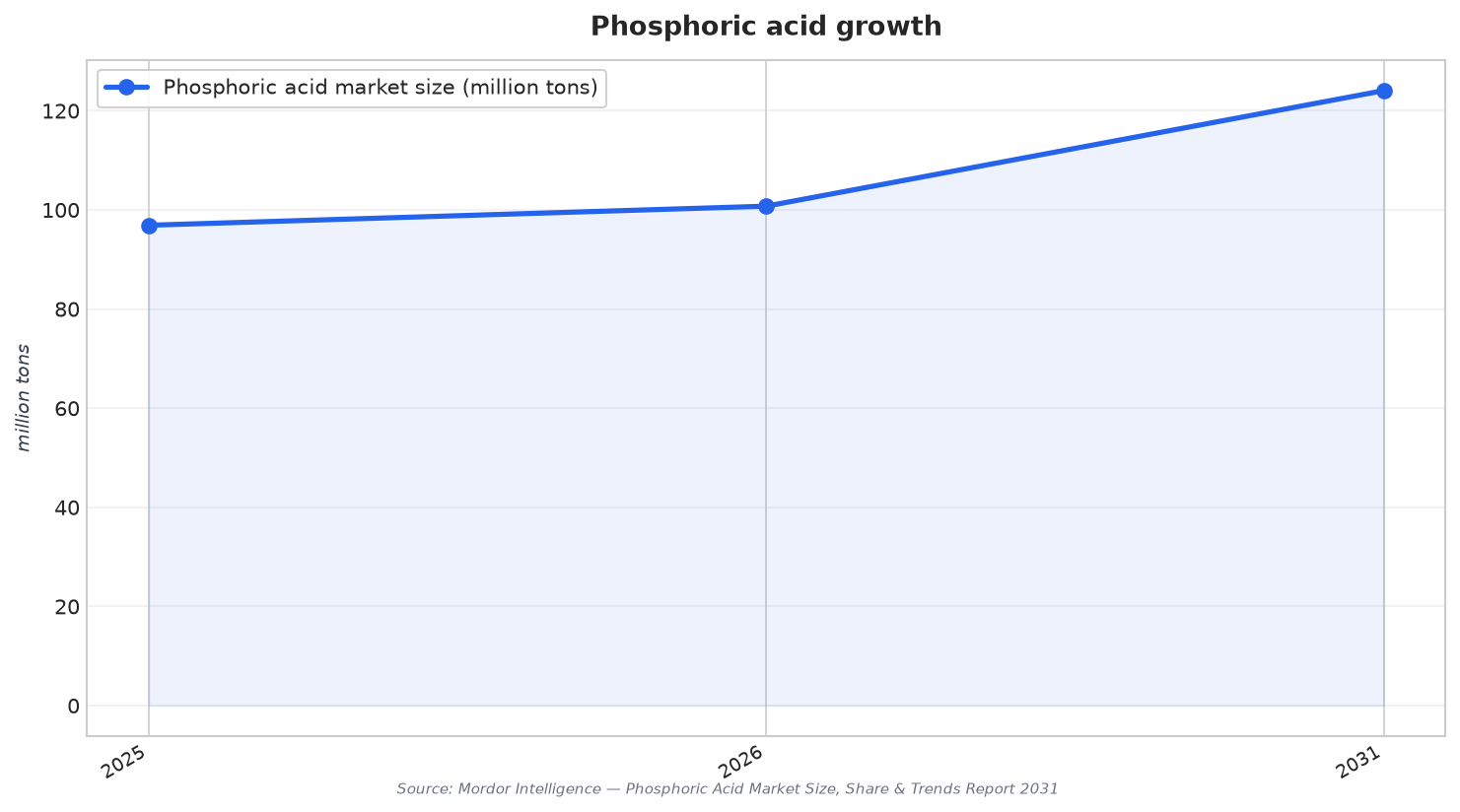
The opportunity is also about portfolio balance, not replacing fertilizer demand. Mordor Intelligence projects the phosphoric acid market to be 96.91 million tons in 2025 and 100.76 million tons in 2026, reaching 124.07 million tons by 2031, growing at a 4.25% CAGR from 2026 to 2031. It says fertilizer led with a 77.49% revenue share in 2025, while the wet process accounted for 90.51% share of market size in 2025. Precedence Research notes that integrated production hubs and vast natural reserves expand the Saudi Arabian market for phosphoric acid, and points to exploring new applications such as batteries as a diversification route. Put together, the path for Saudi producers is to keep scale where volumes are, while building the qualification, purification technology, and customer trust needed to win premium segments tied to LFP and other high-purity uses.
What connects phosphoric acid to LFP batteries?
How big is the global purified phosphoric acid market in the sources?
What do the sources say about Saudi Arabia’s battery-grade phosphoric acid segment today?
What global trends are pushing demand for higher-purity phosphoric acid?
What is the opportunity for purified phosphoric acid in Saudi Arabia according to the sources?