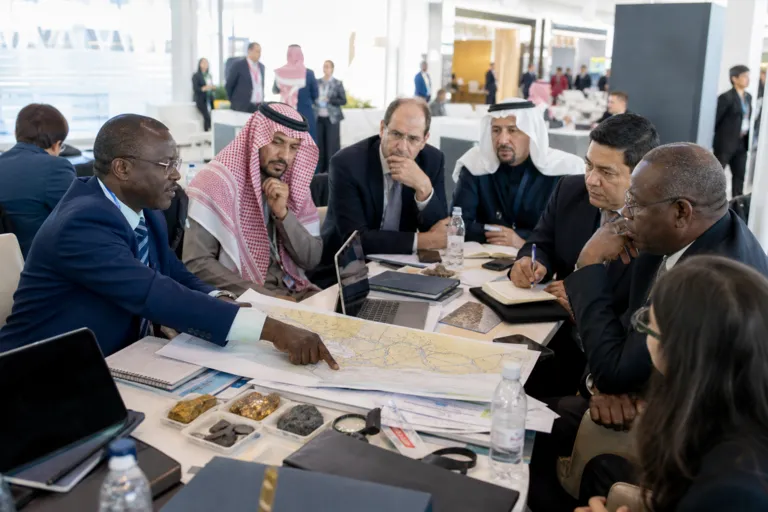
Saudi Arabia is positioning minerals as a shared global priority tied to resilient supply chains, energy transitions, and digital infrastructure. At the Future Minerals Forum (FMF), Saudi officials have described a “future minerals framework” designed to strengthen global collaboration and maximize value creation in supplier countries. The vice-minister, Khalid Al-Mudaifer, framed a major constraint as a funding gap and argued it also creates an opportunity to drive a new phase of development across Africa, Asia, and Latin America. Within that agenda, Saudi Arabia has highlighted collaboration with the World Bank Group to help unlock infrastructure funding across priority mineral corridors in Africa and Latin America.
The FMF narrative is not only about capital. It is also about the enabling conditions that make corridor-style infrastructure investable. Al-Mudaifer identified seven enablers needed to unlock the sector’s potential: supportive policies, financing, infrastructure, responsible mining practices, talent development, technology, and reliable geological data. The same Arab News report pointed to progress on capacity building through three centers of excellence located in Morocco, South Africa, and Riyadh. In parallel, Saudi Arabia has also described efforts to develop an international standard for responsible mining, an element that can shape lender and investor comfort when funding cross-border projects and logistics networks.
From Global Agenda-Setting to On-the-Ground Capital Pathways
While FMF emphasizes multilateral coordination, Saudi-linked dealmaking is also showing up in investment structures tied to minerals. Global Finance Magazine reported that in March, US-based Cove Capital and Saudi Arabia’s AHQ announced a “multibillion dollar” fund to invest in African minerals including cobalt, copper, lithium, and rare earths. In November, the US and Saudi Arabia also agreed to cooperate on mineral supplies aimed at reducing reliance on China, according to the same source. These moves align with a broader strategy described in the article: anchoring supply chains that direct African trade through Gulf logistics hubs before minerals reach global markets, where ports, logistics hubs, and industrial zones become part of the corridor equation.
The wider Gulf context helps show how corridor finance can blend assets, funds, and strategic partnerships, even when approaches differ by country. An AGSI analysis noted that Saudi Arabia signed nine mineral deals valued at $9.3 billion in late 2024 with companies including Vedanta Resources and Zijin Mining Group. It also described Manara Minerals, a joint venture between Maaden and the Public Investment Fund, as a vehicle through which Saudi Arabia has been acquiring stakes in major global mining entities. Global Finance added that Maaden Holding, through Manara Minerals, is pursuing similar deals in Zambia and elsewhere. Together, these steps can complement the Future Minerals Forum mineral corridors Africa agenda by pairing upstream investment with logistics and processing pathways.
Infrastructure funding debates also intersect with broader development finance gaps, especially in Africa. A Clean Air Task Force brief noted that more than 600 million people still lack reliable access to electricity and that clean energy spending in Africa stood at $25 billion in 2022, described as only 2% of the global total. It also cited an estimate of around $133 billion needed each year from 2026 to 2030 to achieve clean energy and climate goals, based on the International Energy Agency’s Africa Energy Outlook 2022. The same brief said Saudi Arabia and the UAE are among the world’s largest international donors and are frequently among the only countries to surpass the 0.7% Official Development Assistance/Gross National Income target. For mineral corridors, this matters because power, transport, and logistics constraints can shape whether mining investments can scale, and whether supplier countries capture more value locally.
What is Saudi Arabia trying to achieve through the Future Minerals Forum’s corridor focus in Africa and Latin America?
Which enablers has Saudi Arabia identified as necessary to unlock mineral-sector potential?
Where are the centers of excellence connected to Saudi capacity-building efforts?
What recent fund initiative was reported for investing in African minerals?
What figures illustrate Africa’s broader infrastructure finance challenge mentioned alongside corridor discussions?