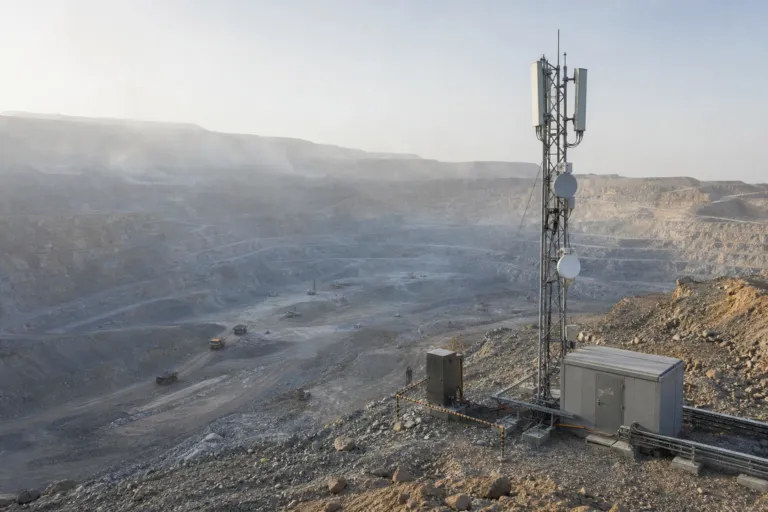
Mine operations depend on connectivity that holds up when terrain, distance, and safety constraints collide. In Saudi Arabia, the policy and market signals around private wireless are increasingly aligned with that reality. Grand View Research notes that the Saudi Arabia private 5G network market held a significant share in 2025, supported by a strong push for digital transformation and smart industrial initiatives. It also points to frameworks published by the Saudi Ministry of Industry and Mineral Resources that encourage advanced wireless systems to support remote operations, worker safety, and real-time analytics. For a private 5G network mining Saudi Arabia use case, those same priorities map directly to daily mine challenges such as connected equipment, protected personnel, and data that arrives in time to act.
Market momentum provides practical context for decision-makers planning site-wide connectivity. MarketsandMarkets values the Saudi Arabia private 5G market at $33.4 million in 2025 and projects it will reach $114.0 million by 2030, representing a 27.9% compound annual growth rate from 2025 to 2030. That growth is described as aligned with Vision 2030 initiatives and driven by enterprise connectivity needs across industrial sectors. While those figures are not mining-specific, they indicate that suppliers, systems integrators, and operators have incentives to build repeatable deployment models for industrial environments. For mine operators, that can translate into more mature offerings for dedicated coverage, predictable performance, and support models built for harsh sites.
What Private 5G Enables on Remote and Hazardous Sites
The underlying capabilities that make private 5G compelling for industry are repeatedly framed around performance and control. Grand View Research highlights ultra-low latency, high bandwidth, and cloud-native capabilities as key enablers for connected solutions in critical sectors. Consegic Business Intelligence defines private 5G networks as cellular networks designed for specific enterprises or industrial facilities to provide secure, high-speed, and low-latency connectivity, supporting industrial automation, remote control, and real-time data analysis. For mines, the operational translation is straightforward: more reliable links for remote operations, stronger foundations for safety monitoring, and better support for real-time analytics workflows. As enterprise programs scale, Saudi operators are also packaging managed security and IoT device management into multi-year contracts, according to Mordor Intelligence, which can simplify operations teams’ burden at site level.
Saudi telecom investment patterns also matter because many mine sites need a blend of wide-area reach and on-site determinism. Mordor Intelligence sizes the Saudi Arabia Telecom MNO market at USD 28.74 billion in 2026 and projects growth at a 6.57% CAGR to USD 39.51 billion by 2031, with stc, Mobily, and Zain KSA cited as major companies. It adds that smartphone penetration exceeds 95% and frames private 5G as a new growth frontier within industrial zones. It also reports that data and internet services led with a 50.88% share of the Saudi Arabia telecom MNO market size in 2025. Technavio, in parallel, cites year-over-year growth of 2.4% for the sector and points to private 5G deployments in industrial zones as an operational reality. For mining programs, these signals suggest active operator attention to enterprise connectivity rather than consumer-only expansion.
Partnership activity and licensing developments help indicate how solutions may reach industrial customers. Grand View Research notes partnerships such as Zain Saudi Arabia and Nokia for cloud-native 5G deployments, and says Nokia collaborates with operators including STC in Saudi Arabia to deliver enterprise-grade connectivity solutions. Mordor Intelligence reports that in December 2024 Nokia and stc launched AI-enabled operations solutions to enhance network efficiency and customer experience, and that in October 2024 Aramco Digital secured a specialized wireless license enabling industrial connectivity services across oil, gas, and logistics sectors. A separate Saudi 5G infrastructure source notes that in 2025 Nokia and Zain KSA partnered to enhance indoor mobile coverage and enterprise 5G connectivity, and states that the Eastern Region is rapidly deploying private 5G networks for mission-critical applications. For mine operators, these moves indicate a growing ecosystem to support industrial-grade networks, with room to tailor designs around safety, reliability, and on-site operational control.
What is driving private 5G adoption for industrial operations in Saudi Arabia?
How large is Saudi Arabia’s private 5G market, according to the sources?
What capabilities are cited as key benefits of private 5G for harsh industrial sites?
Which Saudi operators and partners are mentioned in relation to enterprise or private 5G?
How can private 5G network mining in Saudi Arabia relate to safety and remote operations goals?