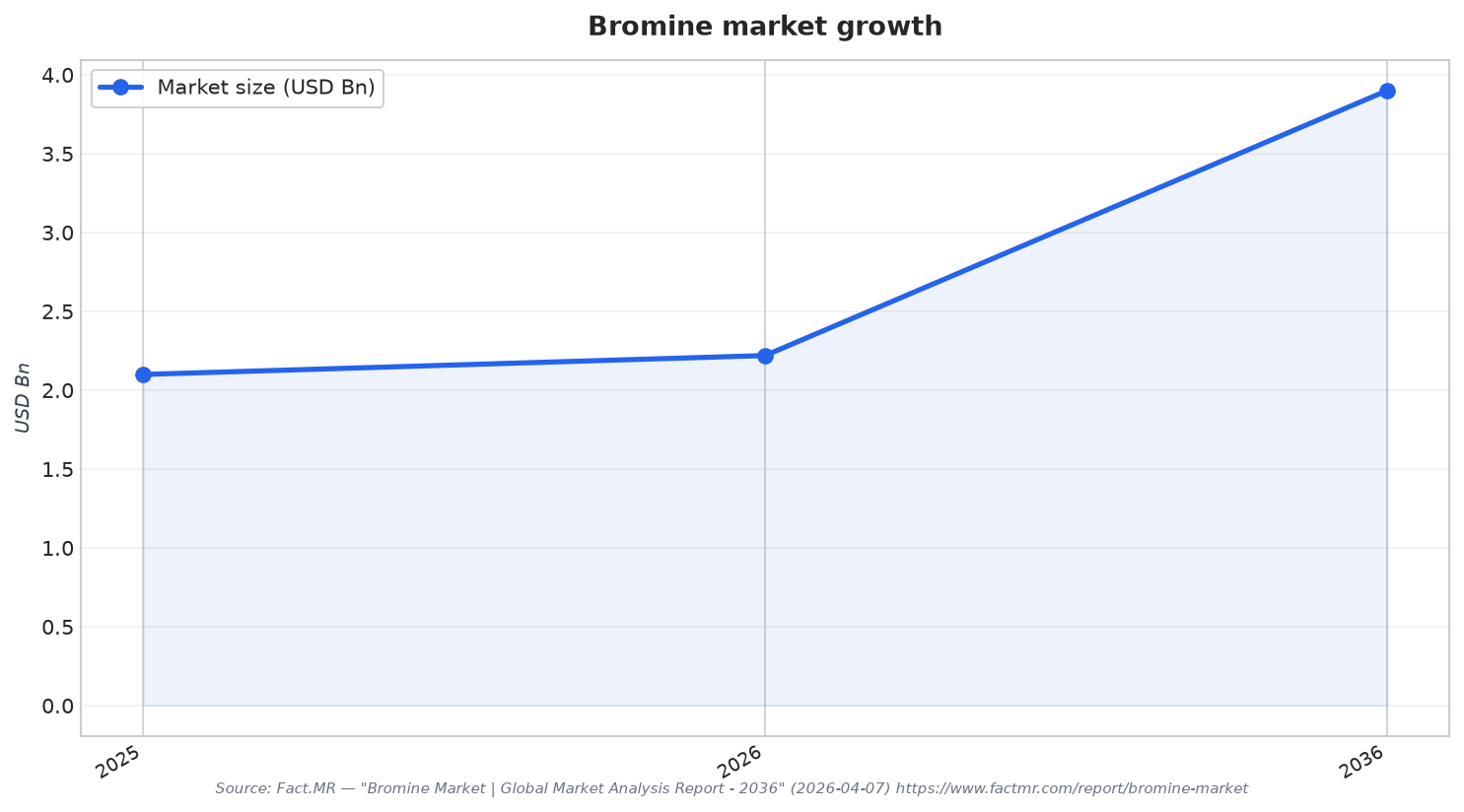
Saudi Arabia’s industrial narrative increasingly includes evaporites and brines, not only hard rock. In global context, salt and bromine sit inside large, growing commodity markets with clear links to chemical manufacturing and water infrastructure. The global salt market was valued at USD 38.07 billion in 2025 and estimated at USD 40.15 billion in 2026, with a forecast of USD 61.43 billion by 2034 at a 5.46% CAGR. For bromine, Fact.MR values the market at USD 2.10 billion in 2025, projects USD 2.22 billion in 2026, and forecasts USD 3.90 billion by 2036 at a 5.80% CAGR. These trajectories help explain why salt and bromine production in Saudi Arabia is being discussed as a chemical-platform opportunity, not just a basic materials story.
Salt underpins industrial chemistry, and the sources point to how big that pull can be. MarketDataForecast notes that, according to the USGS, nearly 43% of salt consumed globally is directed toward chemical production, specifically including chlor-alkali outputs that feed plastics, glass, detergents, and paper. In Saudi Arabia, IndexBox frames the local salt market across vacuum-evaporated, rock, and solar salt, with applications that include food processing, water softening, chemical manufacturing, animal feed, and industrial chlor-alkali production. However, IndexBox only states the market reduced modestly to “$X” in 2025 and shrank by “X%” year over year, so the source does not provide a publishable numeric market value. The more actionable takeaway is the breadth of end uses that can anchor industrial-grade specifications and stable offtake.
From Desalination Brine to Bromine: A Sequential Pathway
Bromine is a brine-linked chemical where extraction and downstream capability matter. Smart Water Magazine describes a sequential route where bromine is too dilute for direct extraction in SWRO brine at 100–134 mg/L, but after a sodium chloride crystallisation step it concentrates in the remaining bittern by an order of magnitude or more, making established extraction technologies viable. The same source reports that Saudi Arabia’s SWA targets 16,000 tonnes annually from this pathway to meet roughly 30% of domestic demand, and cites a $3.8 billion global market with prices at $2,500–4,400 per tonne in that discussion. It also reports confirmed industrial-scale construction underway: two mineral extraction plants at Ras Al Khair, contracted to Chinese and Saudi partners for approximately $65 million, with announced timelines targeting operations in early 2026.
Demand-side pull matters, and bromine’s largest applications connect directly to energy and utilities. Fact.MR states clear brine fluids lead by application with a 41.0% share in 2026, while elemental bromine leads by product with a 50.0% share in 2026. Grand View Research adds that the Middle East held a 13.0% value share of global demand for bromine in 2025, driven by strong oil and gas demand, and points to Saudi Arabia and the UAE investing heavily in exploration and drilling where bromine-based clear brine fluids are widely used. In parallel, the same report highlights demand for bromine-based chemicals in flame retardants, water treatment solutions, and disinfectants as construction projects and public utilities expand. The opportunity is to align extraction with these downstream channels rather than treating bromine as a standalone commodity.
Execution will hinge on managing brine handling costs and environmental expectations while scaling industrial integration. Smart Water Magazine notes that for inland plants relying on deep-well injection or evaporation ponds, brine-related expenditure can climb to 15–25%, while zero-liquid-discharge systems can push brine-related expenditure to 33% or beyond; it adds that evaporation and crystallisation stages alone can consume 60–70% of ZLD capital and operating budgets. The same source also states that four GCC states—Saudi Arabia, the UAE, Kuwait, and Qatar—generate around 55% of global desalination brine, yet no GCC-wide discharge standard exists. For Saudi Arabia, that combination makes project design, compliance readiness, and product quality strategy central to making salt and bromine production durable, investable, and scalable.
What is driving the opportunity for salt and bromine production in Saudi Arabia?
What bromine output target is associated with Saudi Arabia’s desalination-brine pathway?
How big are the global salt and bromine markets in the sources?
Why do clear brine fluids matter for bromine demand?
What do the sources say about brine-management costs and standards in the Gulf?