Saudi Arabia’s mining growth narrative sits inside a wider workforce transformation driven by Vision 2030. The strategy aims to diversify the economy and position mining as a third pillar of national industrial growth alongside oil and petrochemicals. But the constraint is not only capital. It is workforce capability, because on-time launches, controlled budgets, and long-term competitiveness depend on people who are skilled and ready to operate. In that environment, the “missing middle” matters: practical technicians and operators who can bridge the gap between engineers and entry-level labor.
Saudization increases the stakes. For decades, Saudi nationals concentrated in the public sector while the private sector relied heavily on expatriates for technical and leadership roles. Vision 2030 is rewriting that model by boosting Saudi nationals in high-skill, private-sector roles through Saudization under the Nitaqat program. At the same time, the broader economy is pulling on the same talent. Tourism aims to grow annual visitors from 27 million in 2023 to 150 million by 2030. Renewable energy is scaling to supply 50% of electricity. Women’s participation was targeted to rise from under 20% to over 30%, and it is already above that mark. Mining employers are therefore pushed to build real pipelines, not just hire reactively.
Why Job-Linked Training Is Now the Differentiator
Localization signals show why vocational training must connect directly to work. Arab News reported that by the end of 2025 there were 12,946 factories, including 10,394 operational facilities employing around 903,547 workers, with Saudization across the sector at 31%. That context matters for mining because it points to the need for structured pathways that move Saudi trainees into productive roles, not just classroom completion. The same theme appears in skills-gap commentary. Arab News quoted Mustafa Hafez Al-Ansari, deputy CEO of Taiba Higher Training Institutes Co., saying that linking training directly to employment outcomes is essential to closing the gap between skills and market demand.
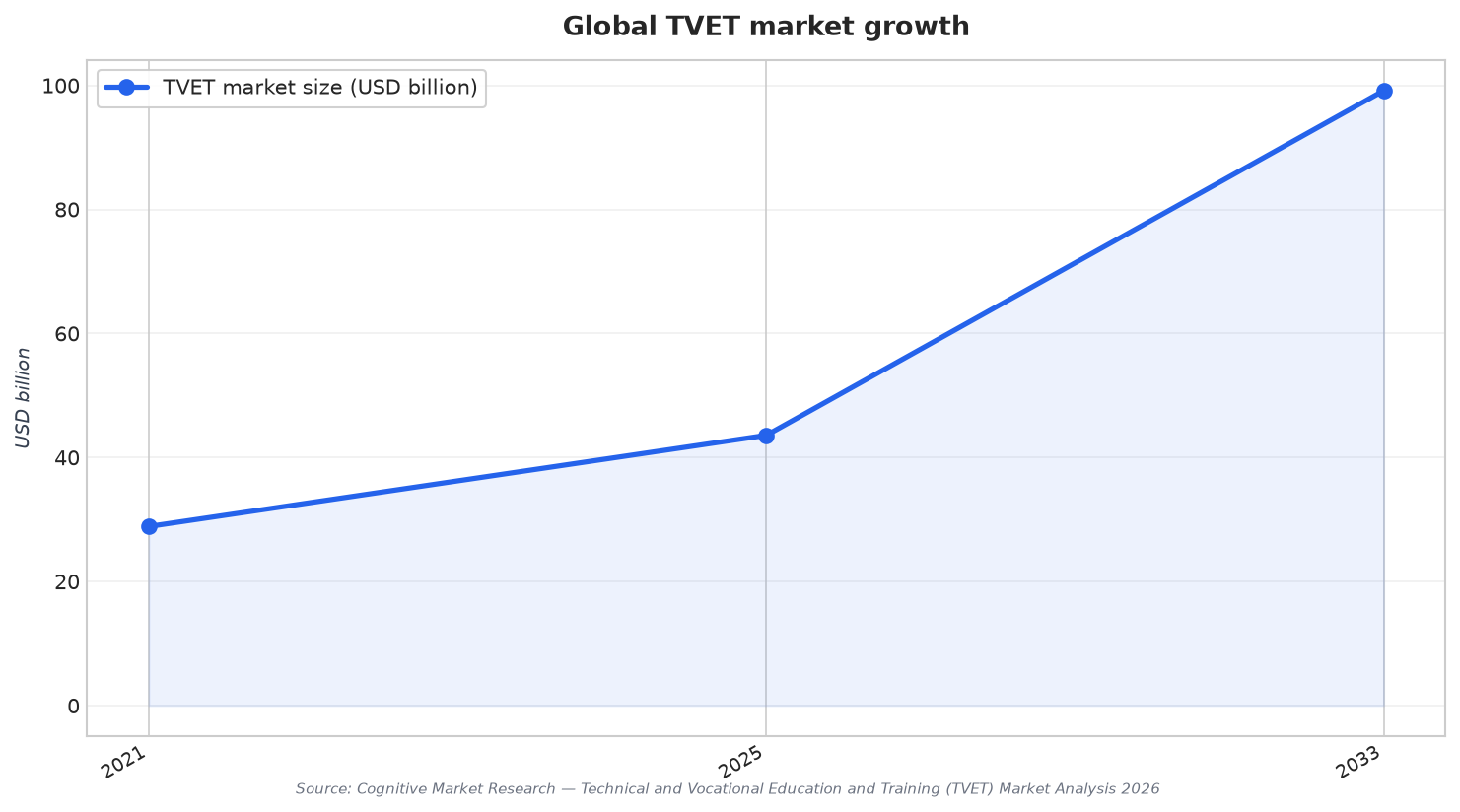
Momentum in the sector increases the urgency to scale technician and operator development. Reported by the Future Minerals Forum (FMF), the number of locally operating mining companies in Saudi Arabia increased from six in 2019 to more than 150 in the past seven years. The country also has a young workforce base, with 70% of its population under 35 years of age. Yet miners are competing with tourism, entertainment, and manufacturing for the same people. This is where mining technician vocational training in Saudi Arabia becomes a pipeline strategy: build site-ready competencies, formalize partnerships, and align providers and employers around what the operation needs.
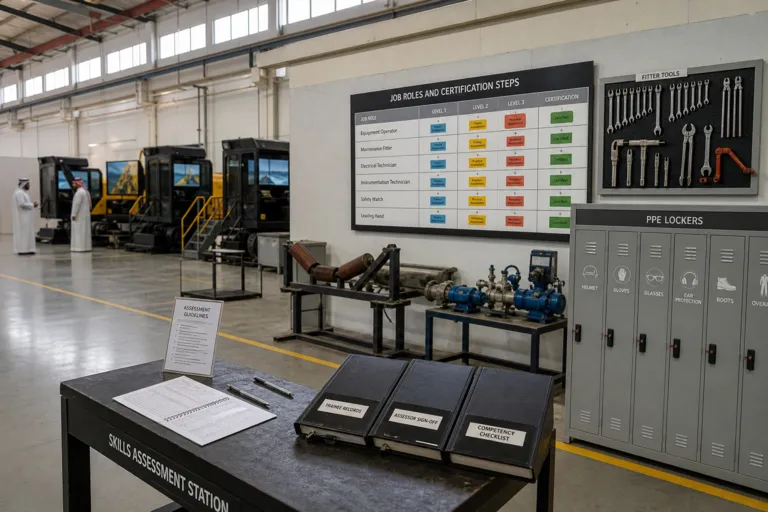
Standardization helps translate that pipeline into hiring and progression. Arab News reported that Saudi Arabia’s mining skills framework covers more than 500 job roles and more than 500 industrial occupations, over 300 professional specialties, 600 skills, and 900 professional certifications. A shared national language for roles supports workforce planning, training design, and advancement ladders across extraction, processing, and logistics. It also complements market signals of expanding activity, such as Arab News reporting that Saudi Arabia exported 5.7 million tonnes of phosphate fertilizer in 2024, up about 6% from 2023, citing GASTAT. For employers, the “missing middle” closes when training outcomes map cleanly to roles, credentials, and real rosters.
What does the “missing middle” mean in Saudi mining workforce planning?
How is Saudi Arabia signaling the need for job-linked vocational pathways?
What role does the mining skills framework play in training and hiring?
How fast is Saudi Arabia’s mining ecosystem expanding in terms of companies?
How can mining technician vocational training in Saudi Arabia be designed to lead to jobs?