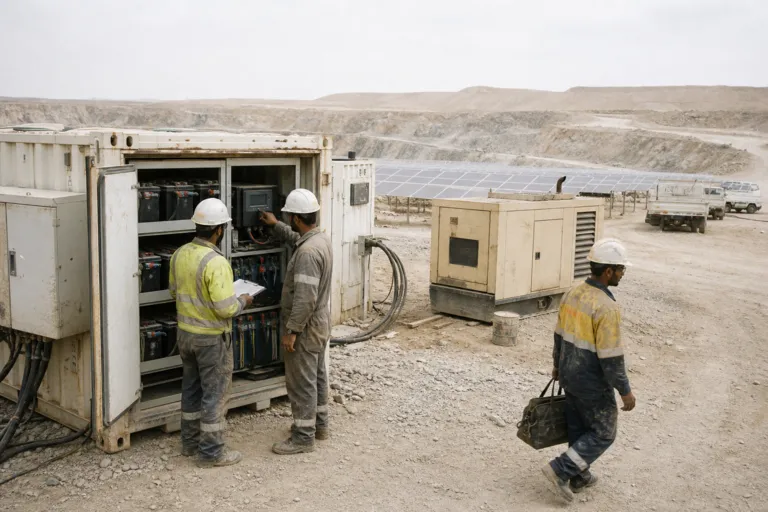
Remote mines need power all day and all night. In practice, many sites have depended on diesel generators to keep operations running and to cover reliability gaps. Industry analysis highlighted by Mining Technology notes that, aside from geothermal, renewable options are intermittent. That makes battery energy storage systems (BESS) critical when mines move to renewables. The same feature reports that, based on GlobalData analysis, solar power generation is currently defining decarbonisation across mining. For remote operations, that pushes hybrid designs to the front. These combine solar with storage, and often keep thermal backup for continuity.
A key Saudi example is Ma’aden’s Al Baitha Bauxite Mine. Under a 30-year power purchase agreement (PPA) with Emerge Energy, the mine is set to be powered by an 8 MWp solar photovoltaic array and a 30 MWh battery storage system. The source describes the hybrid system as designed to ensure 24/7 electricity supply in harsh desert conditions. It is expected to generate 17,300 MWh of clean electricity yearly. It also targets an emissions cut of 13,800 tonnes annually, described as equivalent to removing 3,000 cars from the road.
How Solar-Hybrid Systems Cut Diesel at Mine Sites
Hybrid power changes how diesel is used. Australian Mining explains the operational shift: instead of running continuously, diesel becomes a support asset. The article gives a concrete illustration. A 60 kilovolt-ampere diesel generator supplying a site compound can consume up to 56,064 litres of diesel per year and produce approximately 151 tonnes of greenhouse gas emissions. In comparison, a hybrid configuration such as a battery energy storage system paired with a 45 kilovolt-ampere generator can reduce diesel consumption by up to 21,792 litres per year and cut emissions by approximately 59 tonnes. It also points to fewer refuelling needs and improved efficiency without reducing reliability.
PPAs and on-site power plants are two common procurement paths for mine renewables, according to Mining Technology. The Ma’aden Al Baitha project uses a PPA structure, pairing solar with BESS to address intermittency. SolarQuarter describes a related model in which developers design, build, and operate solar plants near mining sites as “behind-the-meter” systems, with power consumed directly on-site. The same source notes that similar regional developments exist, citing the Kiniero gold project, which installed a hybrid system combining heavy fuel oil with a 21 MWp solar plant.
Not every site will move in a single step, especially when existing diesel fleets are in place. IM Mining describes a staged hybrid pathway at Sadiola, beginning with an expansion of diesel generation capacity by approximately 14 MW, expected to be completed by early 2026. This is followed by a photovoltaic plant with a peak capacity of approximately 35 MW, paired with a 30 MWh BESS and a new control system integrated with diesel generators by mid-2027. The design is intended to supply approximately 40% of the energy requirements of the Phase 1 expansion. For operators planning solar powered mines Saudi Arabia, these examples show practical building blocks: solar, storage, controls, and a managed role for thermal generation.
What does “solar powered mines Saudi Arabia” look like in real projects?
How much clean electricity is expected from the Al Baitha solar-hybrid system?
What emissions reduction is stated for Ma’aden’s Al Baitha project?
How can hybrid power reduce diesel use on mine sites?
Why is battery storage important for renewables at remote mines?