South Korea’s export economy is running hot, but its upstream exposure remains visible. In April 2026, the country posted $85.9 billion in goods exports, a 48% surge from a year earlier, and semiconductors exceeded $30 billion for the second consecutive month. Those downstream strengths matter because batteries, displays, and semiconductors are only as resilient as the minerals behind them. KOMIS trade data for all of 2025 shows a bifurcated picture: meaningful diversification for some inputs, and deep concentration for others. That backdrop is shaping how Korean manufacturers think about supply corridors and prospective new partners.
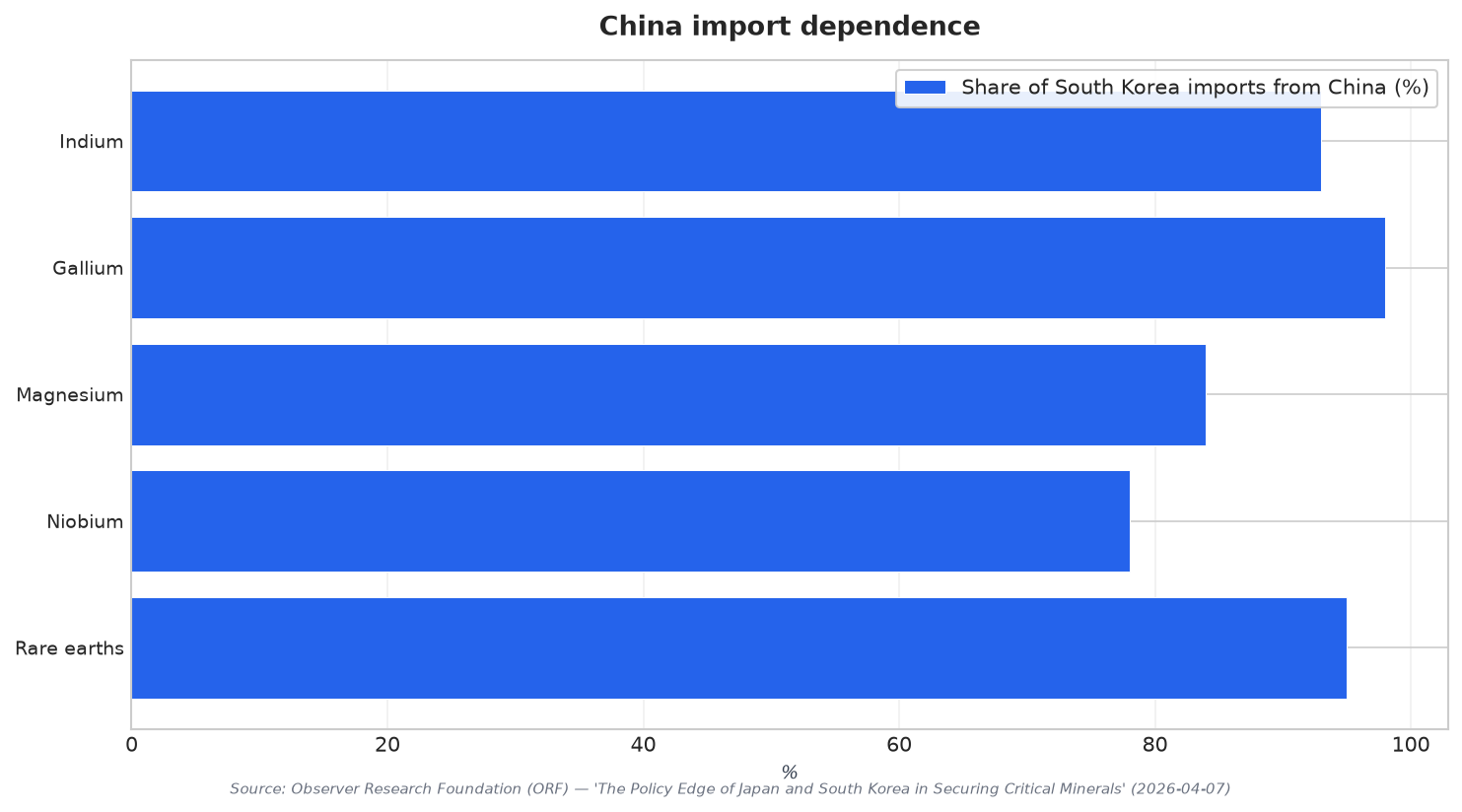
For six minerals tied to South Korea’s most strategically important industries, China’s 2025 share of Korean imports ranges from 14.8% to 94.2%. Indium sits at the high end at 94.2% from China, reflecting how certain display and electronics inputs remain difficult to diversify quickly. Separately, an analysis cited by the Korea Institute of Geoscience and Mineral Resources put South Korea’s net import reliance on critical minerals at more than 99.7%, underscoring that the key question is not whether Korea imports, but how it de-risks who it imports from. Another policy analysis also frames the vulnerability: imports meet nearly 95% of South Korea’s mineral requirements, while rare-earth imports are described as about 95% from China.
Why Supply Diversification Now Looks More Urgent for Korean Battery Value Chains
Recent shifts show that diversification can happen fast when incentives change. After China announced export controls on gallium and germanium in August 2023, China’s share of South Korean gallium imports rose to 73.6% in 2024 as firms stockpiled, then fell to 26.0% in 2025. In 2025, Germany supplied 25.9%, the United States 24.3%, and Japan 18.2%, illustrating how buyers can spread risk in roughly 18 months. Germanium rebalanced even more sharply: Canada reached 70.7% of South Korea’s germanium imports, while China fell to 14.8%, down from 59.3% in 2023. For Korean battery makers and their materials suppliers, these examples act as proof points that concentrated dependencies can be reduced when procurement and processing options exist.
The commercial stakes are also growing inside Korea’s battery materials ecosystem. One industry forecast values the South Korea battery materials market at USD 13.20 billion in 2025, rising to USD 28.92 billion by 2036, with a 7.6% CAGR across 2026–2036. At the same time, company results show pressure and volatility: in Q2 2024, EcoPro reported a consolidated operating loss of KRW 54.6 billion as sales fell 57.2%, and EcoPro BM’s operating profit fell 96.6% to KRW 3.9 billion as sales fell 57.5%. In Q2 2025, POSCO Future M’s operating profit fell 71.7% to KRW 800 million, L&F’s operating loss widened to KRW 121.2 billion, and LG Chem’s advanced materials division reported operating profit down 50.3% to KRW 70.9 billion. Those swings intensify interest in more stable, diversified mineral access and customer demand that rewards non-concentrated supply chains.
In this context, the emerging Saudi Arabia–South Korea critical minerals conversation can be understood as a strategic response to concentrated inputs, rather than a single-commodity story. South Korea holds 26% of the global battery market and has three companies among the world’s top 10 battery manufacturers: LG Energy Solution, SK On, and Samsung SDI. Yet it is also described as facing acute import dependency, including “over 80%” of lithium and cobalt sourced from China in one corridor-focused analysis. In other words, Korean battery makers have strong downstream positions, but their resilience depends on broadening upstream options. That logic helps explain why new cross-regional ties are gaining attention, and why any Saudi-linked minerals agenda would be evaluated against Korea’s measurable diversification needs and its demonstrated ability to shift sourcing when constraints tighten.
Why is South Korea so focused on diversifying critical mineral imports?
What does KOMIS data show about China’s share in key minerals for South Korea?
How quickly has South Korea been able to shift mineral sourcing after export controls?
How does the Saudi Arabia–South Korea critical minerals topic connect to Korean battery makers?
What are the growth expectations for South Korea’s battery materials market?