Saudi Arabia’s circular-economy discussion is moving from concept to industrial pathways, even as core systems remain uneven. Research on waste management and the circular economy in Saudi Arabia notes that upstream design and planning practices are still fundamentally linear. It also highlights that reverse-logistics networks and secondary markets for reclaimed materials are underdeveloped, despite the presence of large-scale recycling facilities. Within that gap sits a clear opportunity for metals. The same analysis says metals, glass, batteries, and electronic waste are rarely recycled at scale and largely end up in landfills or circulate in informal markets. This is the context in which Ma’aden’s recycling ambitions are being interpreted as a practical “close-the-loop” signal.
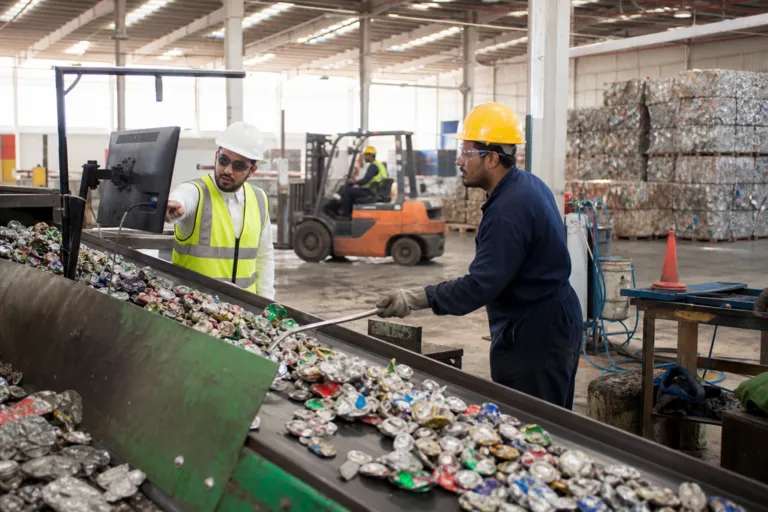
Regionally, the economics of secondary aluminum are already material. A Ken Research overview values the Middle East recycled aluminum market at approximately USD 1.76 billion and links growth to environmental awareness, government recycling initiatives, and demand for sustainable materials across industries. It also describes a market split by scrap type into old scrap and new scrap, with old scrap currently dominating due to increasing end-of-life vehicles and a growing trend of recycling in construction and packaging. For alloy type, the market is divided into wrought alloy and casting alloy, and the wrought segment is leading. Ken Research connects this to automotive and aerospace applications and notes that the automotive sector’s transition toward electric vehicles is increasing demand for secondary aluminum to offset battery weight and improve range.
Why Circular Metals Now: Policy, Infrastructure, and Industrial Pull
Saudi Arabia’s circular transition is also being shaped by policy frameworks and investment models. The ScienceDirect review emphasizes that process-level circular innovations are being developed to close carbon and material loops in energy and petrochemical value chains, but it cautions these practices are largely concentrated in a small number of well-capitalized firms. It also points to localization gaps and a still-small industrial-waste services market, describing on-site recycling more as a future business prospect than a mainstream practice. The paper adds that public–private partnerships are expanding to develop recycling infrastructure and waste-processing facilities. In that landscape, an aluminum recycling plant at Ras Al Khair can be framed as an anchor project that pairs industrial demand with the still-developing collection, sorting, and secondary-materials ecosystem.
Global comparisons show why closing loops for metals is rising on executive agendas, but they also underline how careful Saudi-specific claims must be. A global recycled metal market report states the recycled metal market size was valued at USD 70.23 billion in 2024 and is expected to reach USD 129.33 billion by 2033, at a CAGR of 7.02%. It also says Saudi Arabia is advancing its recycling capabilities as part of Vision 2030, including ambitious plans for waste management reform, and ties momentum to the Saudi Green Initiative supporting modern recycling plants, particularly for aluminum and steel. Separately, the Saudi Arabia circular-economy review provides a global e-waste data point: 62 billion kg of e-waste was generated globally, but only 22.3% is recycled, while noting Saudi e-waste and battery waste management are at a much earlier stage of development.
Ma’aden’s wider aluminum footprint provides a logical industrial home for circular metals, even when public sources focus more on asset descriptions than plant-by-plant recycling metrics. Wood Mackenzie describes the Ras Az Zawr alumina refinery as part of the Ma’aden-Alcoa JV, entailing a vertically integrated aluminum complex from bauxite mine to aluminum semi fabrication, located at the Ras Az Zawr industrial site on Saudi Arabia’s eastern coast. Looking ahead, an IndexBox outlook for Saudi Arabia’s aluminum market says strategic initiatives under the economic diversification agenda may further integrate domestic aluminum production with downstream manufacturing, and that environmental regulations and advancements in recycling technologies will shape the supply landscape. Taken together, these signals explain why the aluminum recycling plant Ras Al Khair narrative is less about a single facility and more about building the reverse-logistics, secondary markets, and reliable scrap streams that circular metals require.
How does Ma’aden’s aluminum recycling plant at Ras Al Khair fit Saudi Arabia’s circular-economy push?
What is the Middle East recycled aluminum market worth, according to the sources?
Which scrap category dominates recycled aluminum in the Middle East?
What do the sources say about global e-waste recycling rates?
How big is the global recycled metal market, based on the provided data?