Nickel sits at the intersection of industrial alloys and battery materials. In Saudi Arabia, that intersection is becoming more commercially visible as storage and mobility supply chains develop. Market research on Saudi Arabia’s unwrought nickel category frames the product boundary tightly around HS 7502 primary forms, such as ingots, billets, cathodes, pellets, briquettes, granules, and shot, while excluding alloys, powders, waste, scrap, mattes, and intermediate products. The same report structure tracks demand, trade flows, pricing logic, and competition with historical coverage for 2012–2025 and a forecast window for 2026–2035. That scope matters when investors discuss new upstream options, because the “battery metal” story often blends products that are not comparable in trade or specification.
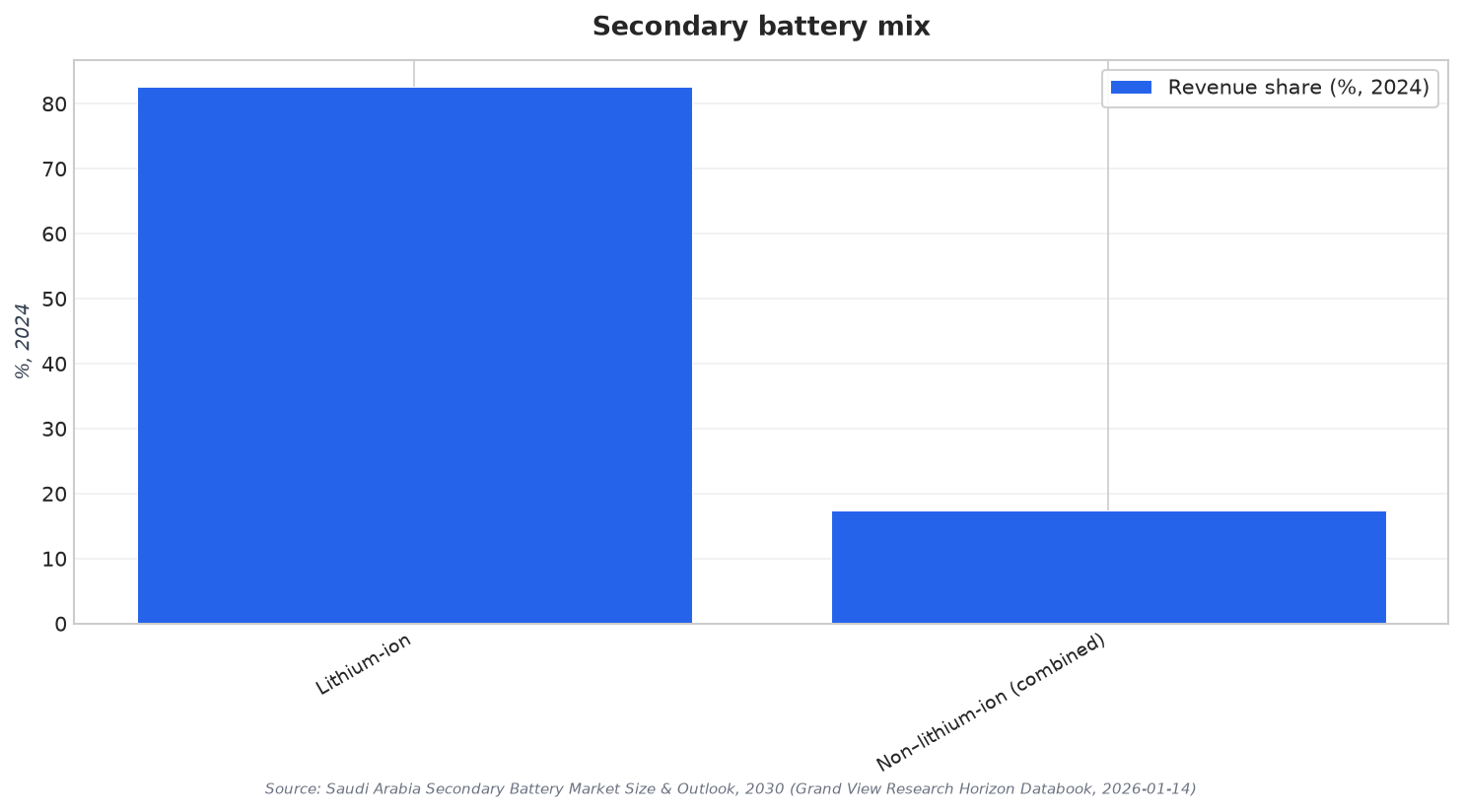
Demand-side signals inside the Kingdom point to growing pull for battery-related materials, even while chemistry pathways remain in flux. Saudi Arabia’s secondary battery market generated USD 1,293.5 million in revenue in 2024 and is expected to reach USD 1,655.6 million by 2030, with a stated CAGR of 4% from 2025 to 2030. Lithium-ion led in 2024, accounting for 82.61% of revenue share, while nickel metal hydride is described as the most lucrative type segment, registering the fastest growth during the forecast period. For nickel-focused strategies, this split matters: it suggests strong near-term lithium-ion weight, alongside a separate growth narrative where nickel-bearing chemistries can still expand.
What Battery Growth Signals Mean for Nickel Supply Planning
Saudi Arabia’s next generation batteries market is described as early stage but fast moving. It is valued at approximately USD 120–180 million in 2026, with stationary storage representing 60–70% of revenue. The same outlook expects annual expansion of 30–35% through 2028 and projects a market value of USD 500–700 million by 2030, while also stating a projected compound annual rate of 28–35% from 2026 to 2035. It also links momentum to a national ambition to integrate 50 GW of renewable energy by 2030. For nickel planning, these figures do not prove local ore supply, but they do define why supply security, specification control, and processing readiness can become strategic topics in parallel with deployment growth.
Trade behavior adds another lens to the “frontier” narrative around nickel mining in Saudi Arabia, because imports can reflect both demand and supply gaps. In a Middle East view of imported nickel-cadmium, nickel metal hydride, lithium-ion, lithium polymer, and nickel-iron accumulators, Saudi Arabia is listed at 7.2 million units in 2024. In value terms, Saudi Arabia is shown at USD 599 million, representing a 22% share of total Middle East imports in that grouping, second to Turkey. The same source cites Saudi Arabia’s average annual import growth rate at +22.1% per year over 2013–2024 and highlights a Saudi import price of USD 83 per unit, contrasted with USD 10 per unit for the UAE. These figures are regional battery-import context, but they help explain why domestic material strategies can draw attention.
At the strategy level, external commentary on Saudi Arabia’s battery materials ambitions underscores both upside and uncertainty. One projection says global installed capacity could expand ninefold between 2024 and 2040, creating demand for lithium, cobalt, nickel, and copper, while also warning that rapid progress in solid-state and sodium-ion technologies could reduce demand for traditional lithium-ion materials. It also claims European battery manufacturers currently source processed lithium, cobalt, and nickel exclusively from Chinese refiners due to limited alternative processing capacity, positioning non-Chinese processing options as a diversification lever. For Saudi stakeholders discussing the Arabian Shield as a possible nickel story, the practical takeaway is not a guaranteed mining outcome; it is the need to align any upstream ambition with downstream qualification timelines, processing realities, and shifting chemistry risk.
What does the unwrought nickel market scope cover in Saudi Arabia?
How fast is Saudi Arabia’s secondary battery market expected to grow?
What share did lithium-ion hold in Saudi Arabia’s battery revenue in 2024?
How big is Saudi Arabia’s next generation batteries market in 2026 and 2030?
What does the article suggest about nickel mining opportunities in Saudi Arabia?