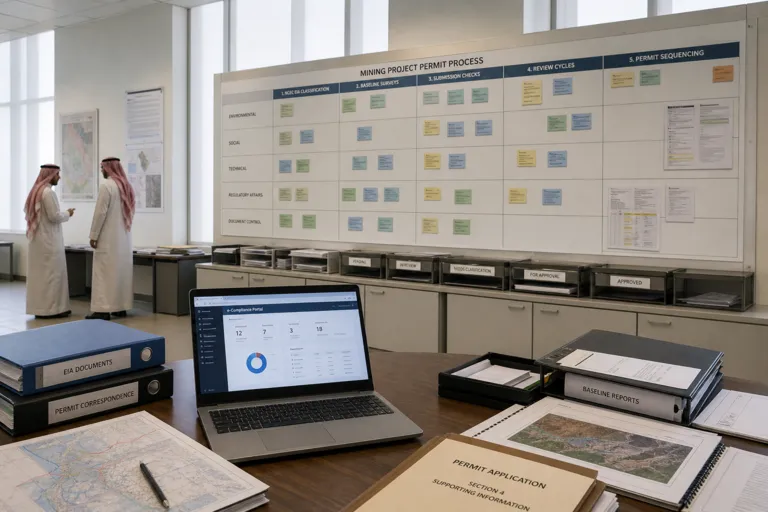
A mining project’s Environmental Impact Assessment (EIA) in Saudi Arabia is more than a report for approval. It is a risk-management tool that evaluates how a proposed activity may affect air, water, soil, drainage, communities, ecosystems, waste handling, and surrounding land use. In practice, NCEC-aligned EIA work is often triggered by activities with emissions, wastewater, waste, traffic, construction impacts, or sensitive nearby receptors. For mining developers, the key is to treat the EIA as a structured pathway: start with classification, build a defensible baseline, define project-specific mitigation, and package documentation for an environmental permit to construct before any construction or modification begins.
Classification determines both scope and the sequence of studies. Published Saudi guidance describes two EIA depths: Initial Environmental Screening (IES) for low or minimal impacts, and Detailed Environmental Impact Assessment (DEIA) for large or complex projects with significant or sensitive effects. Separate NCEC-oriented permit guidance also describes three impact categories, including cases where a scoping report is required before a full EIA for the construction permit. For mining teams, this means early clarity on size, nature, and expected impacts can prevent rework later. It also frames the deliverables NCEC typically expects, such as baseline data, impact assessment, mitigation commitments, monitoring requirements, and environmental management plans.
NCEC Requirements and Realistic Timelines: What to Prepare
A credible baseline is the foundation of the EIA package. Saudi EIA guidance describes baseline studies that record current conditions before construction or operation, including air quality, noise, soil, groundwater, surface water, drainage, land use, and nearby sensitive receptors. Monitoring is positioned as measurable evidence for EIA conclusions and future compliance, supporting construction controls and operational reporting. This is also where many applications fail: common mistakes include incomplete project descriptions or location data, weak baseline data that does not reflect actual site conditions, missing impact topics (air, noise, soil, water, drainage, waste, or sensitive receptors), and generic mitigation measures instead of project-specific Environmental Management Plan (EMP) and Construction Environmental Management Plan (CEMP) commitments.
For permit submissions, the process is typically described as screening and document collection, then baseline review, impact assessment, preparation of management and monitoring plans, submission support, and responses to technical comments. Applications are filed through the NCEC e-Compliance portal. One published checklist for environmental permits states that required documents can include an approved environmental assessment study, engineering drawings in AutoCAD or PDF format, a recent and valid commercial registration, and compliance certificates from relevant authorities such as Civil Defense and the municipality. The same source also states that an EIA study must be prepared by an NCEC-approved consulting office, and that the study includes a detailed project description and raw materials used, expected impacts on air, water, soil, and biodiversity, plus an EMP to mitigate negative impacts.
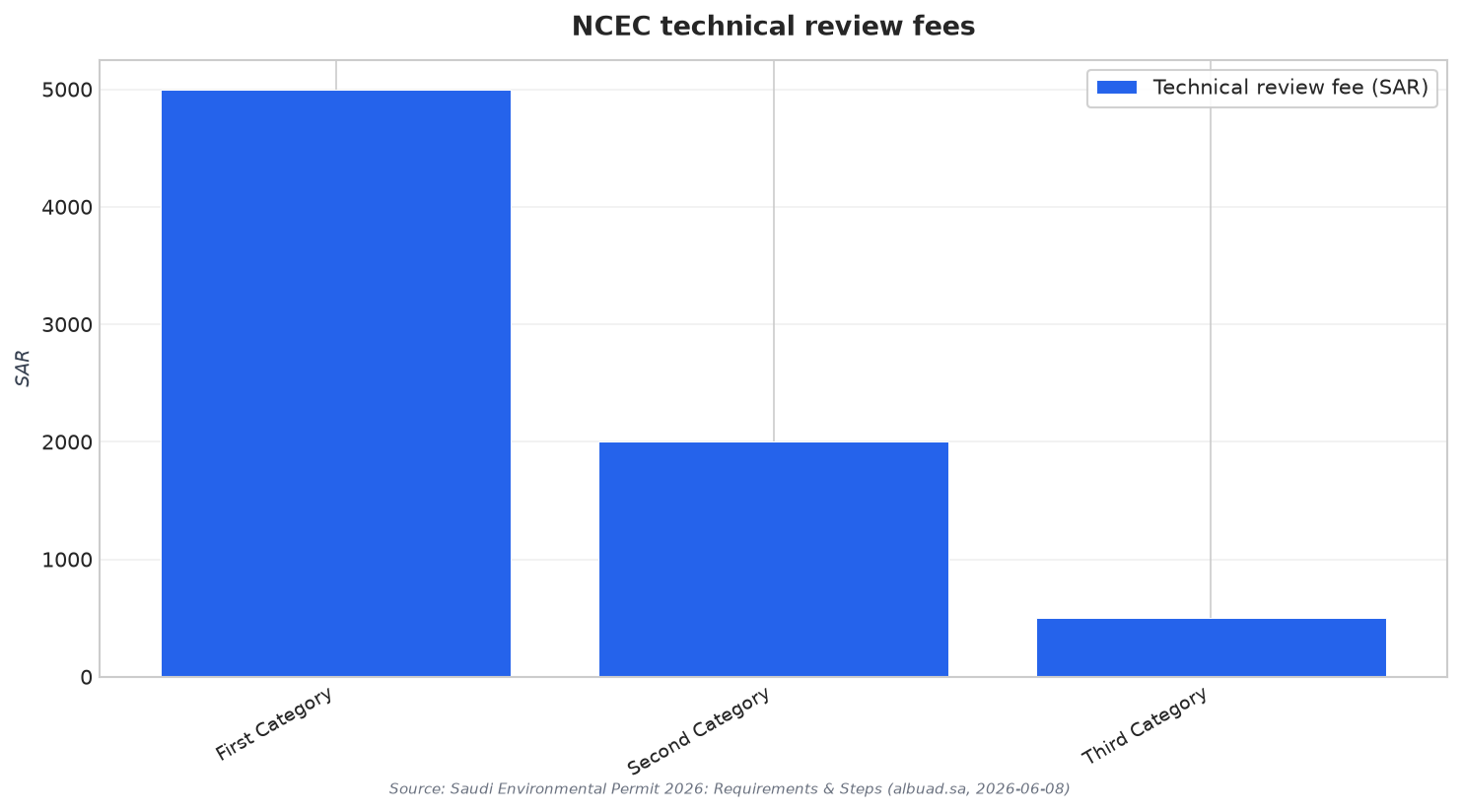
Timelines and fees are often the most practical planning inputs for a mining schedule. One Saudi environmental permit guide states a duration of 2 to 4 weeks, depending on project complexity, and also states that NCEC teams review documents within 10 working days. The same source lists technical review fees of 500 SAR for the Third Category, 2,000 SAR for the Second Category, and 5,000 SAR for the First Category, with payment made electronically through the SADAD platform. More broadly, Saudi environmental regulation ties NCEC compliance and EIA rules to national policy goals, including the Saudi Green Initiative launched in 2021 and a net-zero greenhouse gas emissions commitment by 2060, reinforcing why mining EIAs should be built for both approval and long-term compliance.
When does a mining project in Saudi Arabia typically need an EIA?
What are the main EIA study types used in Saudi Arabia?
How long can the NCEC-oriented environmental assessment and review take?
What fees are listed for technical review by category?
What should teams prioritize in a Saudi Arabia mining environmental impact assessment to avoid delays?