Direct lithium extraction is moving fast from research into pilots, and the phrase direct lithium extraction Saudi Arabia is increasingly tied to oilfield brine potential. Saudi Aramco has reported zones of lithium concentration of up to 400 parts per million on its existing operational lands, according to reporting on the Aramco–Ma’aden joint venture. The same reporting says early studies suggest commercial lithium production could begin as soon as 2027, described as an aggressive timeline. The opportunity is paired with realities: commercialisation timelines are measured in years and hinge on discovery, permitting, infrastructure rollout, and market conditions.
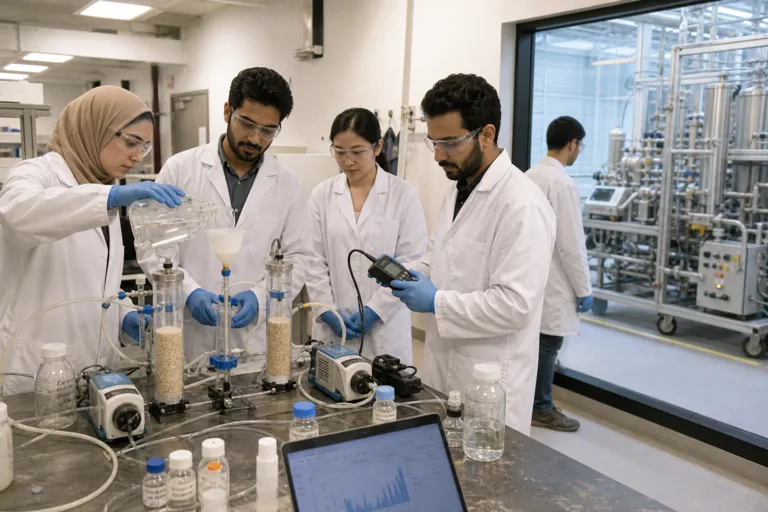
The “lab to pilot” pathway is being shaped by a broader wave of DLE innovation. Recent research coverage highlights “new processes” that directly extract lithium from dilute sources. Scientific work also points to electrochemical approaches, including a “decoupled and membrane-free electrochemical cell design” for lithium extraction from brine. These advances matter for oilfield brines because produced water streams can be complex, and adaptable processes are attractive. The same body of work cites pilot-scale engineering for brine processing, underscoring that scalable hardware and repeatable recovery rates are central when moving from controlled experiments toward field operations.
From Oilfield Brine Concepts to Commercial-Grade Pilots
Evidence of what “pilot readiness” looks like comes from outside Saudi Arabia, and it sets a benchmark for what local pilots may try to match. Reuters reported Albemarle completed validation of its DLE pilot plant in Chile, enabling final design of a future commercial facility and progress to environmental review. In that validation, lithium recovery exceeded 94% during stable operation, the pilot ran for over 3,000 hours (more than 90 consecutive days), and water reuse reached up to 85%. Reuters also reported Albemarle allocated $30 million to the pilot plant and $216 million to a salt recovery plant in the Atacama salt flat.
Other brine pilots show how performance can be communicated in engineering terms. A cited pilot-scale cell used an electrode surface area of 33.75 square meters to realize lithium extraction from Dead Sea brine with a recovery rate of 84.0%, along with energy savings of up to ~21.5% by harvesting osmotic energy of brines. Separately, Mining.com reported Albemarle’s “Transition to Direct Lithium Extraction (TED)” project in Chile is a $3.1 billion project under environmental review that would integrate DLE alongside existing solar evaporation methods, “nearly doubling lithium recovery,” and could return roughly 90% of processed brine to the salt flat. These figures illustrate the types of recovery, runtime, water reuse, and brine-return claims that often define pilot success.
For Saudi Arabia, the pilot question is tightly linked to industrial execution. Mining.com.au says Aramco brings advanced drilling expertise, geological databases spanning 90-plus years, and an integrated supply chain to accelerate mining ambitions, while Ma’aden adds mining focus. The same source stresses the mining sector is capital-intensive and requires patient investment, and that workforce development and technology transfer will influence how quickly ventures mature. That context is critical if Saudi oilfield brine DLE projects aim to translate reported lithium zones up to 400 ppm into a commercial outcome on a 2027 horizon.
What does “direct lithium extraction Saudi Arabia” refer to in current reporting?
What pilot metrics show whether DLE is working at scale?
Are there examples of DLE pilot performance in other brines?
Why is the 2027 Saudi commercial target described as aggressive?