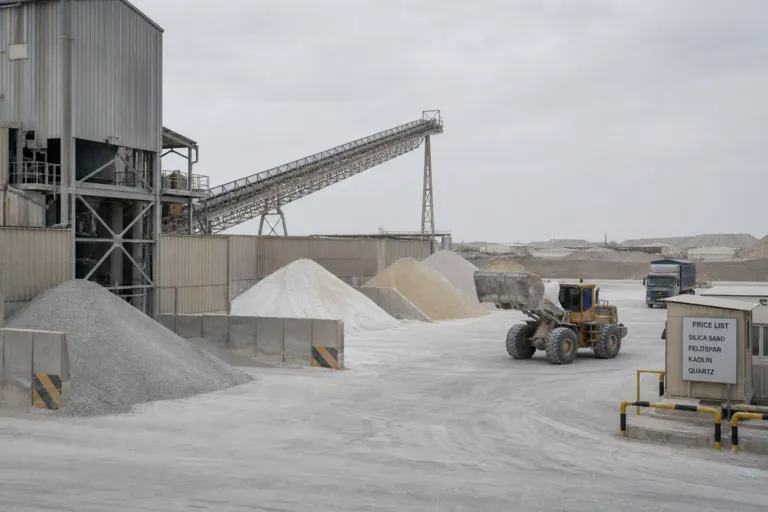
Saudi Arabia’s mining narrative is increasingly about more than metals. In MENA, industrial minerals are defined as non-metallic, naturally occurring geological materials mined and processed for their physical and chemical properties, and the category explicitly includes feldspar, kaolin, and silica sand. These minerals sit at the heart of ceramic and glass-making supply chains, alongside bulk construction uses and more functional applications. This matters because regional demand is being pulled in two directions at once: traditional heavy industry and construction on one side, and more specification-driven manufacturing on the other. For Saudi Arabia, the opportunity is not just extraction, but also processing, logistics, and reliable delivery into end-use manufacturing.
Silica sand provides a clear example of how the Middle East market is evolving and where Saudi Arabia fits. In the Middle East, Turkey dominates consumption and production, accounting for 14 million tons of consumption and 13 million tons of production. That same report places Turkey’s 14 million tons at 76% of regional consumption, with Iran at 1.5 million tons and Saudi Arabia as the third-largest consumer at 1.3 million tons. Yet trade leadership can look different from consumption leadership: Saudi Arabia is cited as the leading export value leader at USD 44 million, serving external global markets. These contrasts highlight why industrial minerals strategies often depend on processing, quality, and market access as much as raw tonnage.
From Construction to High-Purity Specs: What Changes the Game
End-use demand signals are also shifting toward higher purity and tighter specifications. The Middle East silica sands report describes a demand profile increasingly split between traditional uses such as glass manufacturing, hydraulic fracturing support, and construction materials like cement and ceramics, and advanced technology applications. It specifically notes rising demand for high-purity and ultra-high-purity quartz sand linked to solar PV, electronics, specialty glass, and silicon metal production. On pricing, the same source highlights volatility: the regional export price fell to USD 53 per ton in 2024 after peaking at USD 200 per ton, while import prices strengthened to USD 81 per ton. For operators and investors, this is a reminder that quality differentiation and supply chain positioning can be as important as headline demand growth.
Saudi-specific market signals reinforce the theme of industrial scale-up and downstream pull. A Saudi Arabia silica sand report states the market attained a volume of 712.95 KMT, and it cites a July 2024 development where Mohammed Hadi Al Rashid & Partners Company (Al Rashid) secured a mining license for a high-percentage silica mine in the Riyadh region under license number 1446632. Another Middle East silica sand study values the regional market at USD 434.39 million in 2025 and projects growth at a CAGR of 6.80% between 2026 and 2035, reaching USD 838.67 million by 2035; it also notes an AMAK plan to set up a closed joint stock company with Esan and ARMICO-Fujairah to invest in industrial minerals and related manufacturing across Saudi Arabia. These developments sit alongside demand drivers mentioned across sources, including construction, oil and gas, and solar-related requirements for higher-purity sand.
The broader opportunity in industrial minerals—covering feldspar, kaolin, and silica sand—ultimately depends on connecting geology to manufacturing outcomes. Lucintel points to applications for industrial silica sand in Saudi Arabia including hydraulic fracturing, glassmaking, foundry, and ceramic & refractory markets, and it flags rising need for high-purity sand as a key driver. It also describes trends such as digital transformation in operations, sustainable mining and environmental practices, and the growth of local and regional supply chains to reduce dependency on imports. Put together, the case for industrial minerals in Saudi Arabia is not a single-commodity story. It is an integrated play across extraction, processing, and industrial customers, with feldspar and kaolin positioned alongside silica sand as ceramic and glass-making minerals within the MENA industrial minerals framework.
How does the industrial minerals feldspar and kaolin opportunity in Saudi Arabia connect to silica sand?
What do the sources say about Saudi Arabia’s role in Middle East silica sand trade?
How volatile have silica sand prices been in the Middle East?
What Saudi Arabia-specific project or licensing detail is cited for silica sand?
Which applications are highlighted for industrial silica sand in Saudi Arabia?