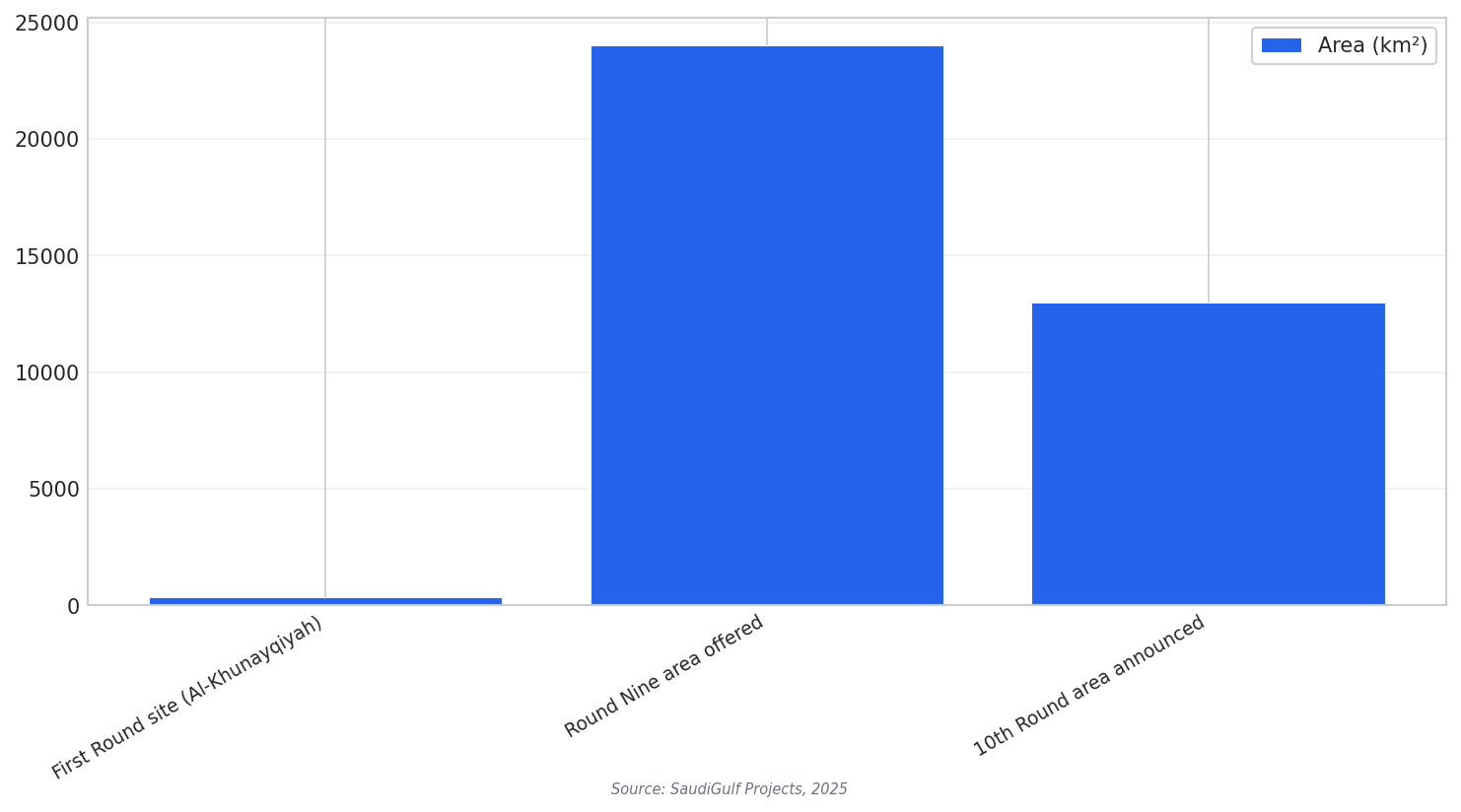
The Saudi Arabia exploration licensing round process is shifting fast. The Ministry of Industry and Mineral Resources (MIM) is moving from smaller, limited plots to large mineralized belts. Vice Minister Khalid Al-Mudaifer said earlier licensing rounds offered areas that did not exceed 100 sq. km per license. He linked the move to larger areas to investor demand and to Saudi Arabia’s resource potential that has not yet been accurately determined.
This “belt” approach is now visible in the latest rounds. In the ninth exploration licensing round, MIM named 24 companies and consortia as winners. They were awarded 172 mining sites. This included 76 sites that advanced to a multi-round public auction. The awarded sites sit across three mineralized belts in the regions of Riyadh, Madinah, and Qassim, with total committed exploration spend of over SAR 671 million during the first two years of work programs.
Round Nine also showed how big the footprint has become. The ninth round offered over 24,000 sq km. It spanned the Ad-Duwaihi/Nabitah gold belt in the Riyadh region, and the Nuqrah and Sukhaybirah/As-Safra gold belts in Madinah and Qassim. These areas are described as rich in strategic minerals, including gold, copper, silver, zinc, and nickel.
Round Ten: New Sites, Wider Regions, Clearer Data Access
After Round Nine, the 10th round opened new ground. MIM announced the 10th round of exploration license competitions across three mineralized belts covering a total area of 13,000 km². The belts span five regions: Madinah, Makkah, Riyadh, Qassim, and Hail. The ministry said these include new exploration sites that extend from belts offered in the Ninth Round.
The 10th round highlights specific belts and known projects. The Nabithah/Ad Duwayhi (Dahlat Shabeb) Belt includes the Ad Duwayhi Mine, with an annual production capacity of about 180,000 ounces of gold. The Sukhaybarat/Al-Safra Belt is described as one of the most important belts and includes projects such as the Sukhaybarat Mine, with estimated resources of 729,000 ounces of gold, and the Bulghah Mine, which produces more than 50,000 ounces of gold annually. The Al-Nuqrah Belt hosts significant gold deposits and volcanic massive sulfide (VMS) mineralization rich in copper and zinc deposits.
The ministry is also trying to reduce uncertainty for bidders. For Round Ten, the prequalification stage remains open until December 15, 2025. Geological and technical data for the sites are available on the Taadeen digital platform, including previous license reports and survey data. A multi-round live auction is planned for the first quarter of 2026, where companies compete based on exploration spending commitments for contested sites.
What happened in the Saudi Arabia exploration licensing round (Round Nine)?
How large was the area offered in Round Nine?
What is the total area and regional coverage of the 10th round?
When do Round Ten prequalification and auctions take place?
Why did Saudi Arabia expand from small licenses to mineralized belts?