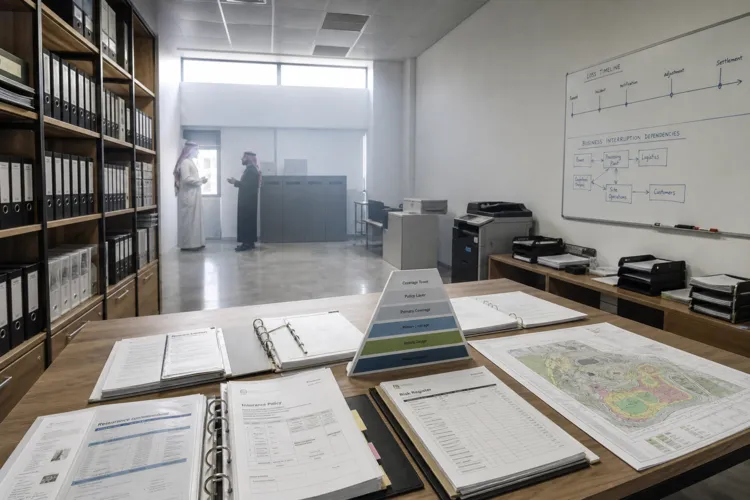
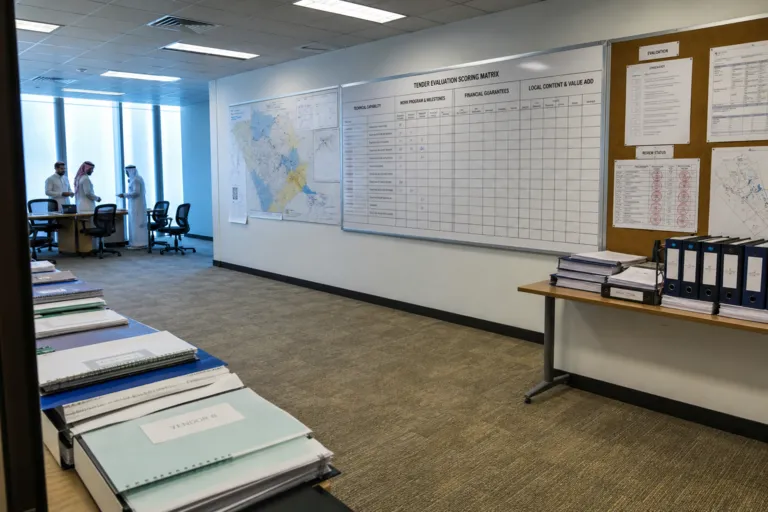
Saudi Arabia is expanding competitive access to mineral opportunities and tightening how bids are judged. In 2026, the Ministry of Industry and Mineral Resources qualified 24 local and international companies and consortiums to compete for mining exploration licenses across three multi-mineral belts covering about 13,000 square kilometres in five administrative regions: Madinah, Makkah, Riyadh, Al Qassim, and Hail. The same push for standardisation that shows up in public procurement also influences how bidders should think about exploration: the bid is not only a promise of geological intent, but a deliverable work program, a financial plan that can carry it, and a localisation model that is measurable in Saudi spending, jobs, and supply chains.
Work programs matter because they translate prospectivity into executed meters, samples, and decisions. The belts being offered sit in the Arabian-Nubian Shield and are described as highly prospective for hard rock targets, including VMS-style systems. While the sources do not publish a single scoring template for mining licenses, they do show how Saudi authorities increasingly rely on evaluated criteria and auditable mechanisms in competitive processes. In government procurement, the Government Tenders and Procurement Law (GTPL) establishes standardised tendering procedures and evaluation criteria, and Etimad is the centralised electronic system used for publishing tenders above specified thresholds. For exploration, bidders can align with that mindset by presenting a clear program with milestones, governance, and data quality that can be reviewed and compared, not just described.
Local Content Turns Bid Quality Into a Measurable Score
Local content is no longer a soft preference in Saudi competitive evaluation; it is treated as a scored and enforced criterion. Local content reached about 47% of government procurement in 2024 against a 45% target, and the Local Content and Government Procurement Authority (LCGPA) is scaling adoption through Etimad mechanisms. LCGPA reported that tenders incorporating local content mechanisms on Etimad reached SR316.4 billion, an implementation rate of 94.1% of total tender value. Another snapshot shows local-content mechanisms applied to 8,600 Q2 tenders worth SAR63bn. For bidders, the practical message is to build a defensible local content baseline and target using clean finance, HR, and procurement data, because categorisation and auditability are positioned as decisive.
Financial capacity and price competitiveness are also shaped by localisation rules that change how offers are evaluated. Above a high-value threshold cited as SAR 25 million (with a note to confirm the current figure), financial evaluation weights price at 60% and local content at 40%. Some products can carry an additional preference of up to 20%, and bids from non-SMEs are treated as 10% higher against local SMEs in eligible contracts. The local-content score itself can combine baseline and target performance, with five points added for companies listed on the Saudi Exchange. For foreign companies, one guide warns they may start with a local content score near zero, making early planning on Saudi staffing, local suppliers, and operating presence part of bid engineering rather than a post-award task.
To compete against these exploration license bid evaluation criteria in Saudi Arabia, bidders should treat “local value” and “ability to execute” as linked. Between 2020 and 2024, spending by PIF, its programs, and portfolio companies on local content reached SR591 billion ($157 billion), underscoring the scale of the localisation lever across the wider state ecosystem. In some tender categories, LCGPA has also introduced minimum thresholds, including a 30% minimum local content requirement for certain government management consulting and IT services tenders, and it has announced timelines that connect requirements to tender sizes. While mining licensing is not described as identical to these tenders, the direction is clear: work programs must be credible, funding must be demonstrable, and local content must be quantified, certified where required, and sustainable across the project lifecycle.
What does Saudi Arabia consider in exploration license bid evaluation criteria?
How many companies qualified to compete for Saudi mining exploration licenses in 2026?
How large are the areas covered by the 2026 multi-mineral belts?
How widely are local-content mechanisms used on Etimad?
When local content is weighted in evaluation, how can it change bid outcomes?