Saudi Arabia is pushing mining and technology forward under Vision 2030. Mining is a key pillar for economic diversification. Artificial intelligence is now changing how companies search for minerals, plan fieldwork, and decide where to drill. This is why “AI in mineral exploration” is becoming a core phrase in the Kingdom’s mining story.
Several Vision 2030 goals show why faster exploration matters. One 2026 target is to increase mining sector GDP contribution from $17 billion to $64 billion. Another target is 90,000 mining jobs by 2026. At the same time, Saudi Arabia is promoting AI adoption through policies, funding, and regulatory frameworks, including the Mining Investment Law.
Market signals also point to rapid change. The Saudi Arabia AI in Mining Market is projected to grow at a CAGR of 38.40% by 2032. This growth is linked to digital transformation initiatives, government support, and rising investments in automation. For exploration teams, the biggest promise is speed, because AI can process massive datasets faster than traditional workflows.
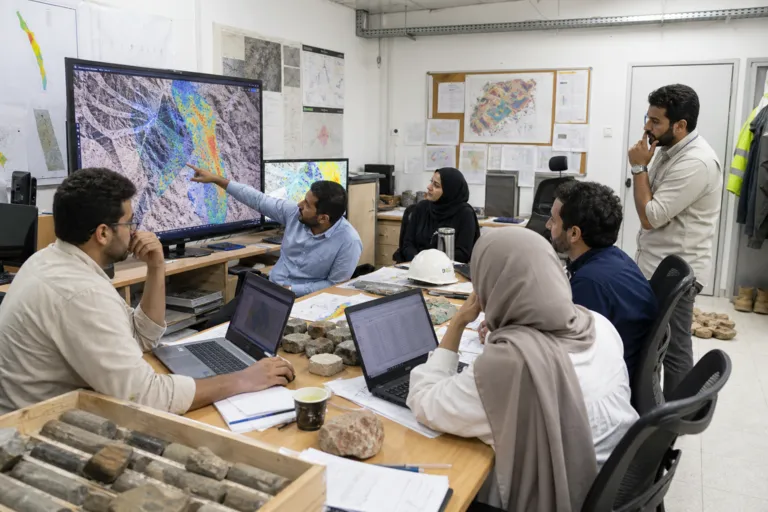
AI is also helping Saudi Arabia use existing information in smarter ways. One example is work on Saudi Arabia’s GCAS stream sediment dataset, which includes trace elements such as gold (Au), copper (Cu), and arsenic (As) from tens of thousands of samples. A structured workflow can standardize metadata, handle detection limits, and then use outlier detection methods such as interquartile range (IQR) and Isolation Forests to spot subtle, multi-element anomalies.
From Raw Data to Clear Targets in the Arabian Shield
After anomalies are identified, they can be checked against the Saudi MODS database of known mineral occurrences. This can confirm that many anomalies are relevant and also reveal “blind” anomalies in areas with no documented mineralization. Element association “fingerprints” can then be derived near known deposits and compared with unexplained anomalies to infer likely commodity associations, supporting targeted predictions for gold, copper, nickel, and other mineralization types.
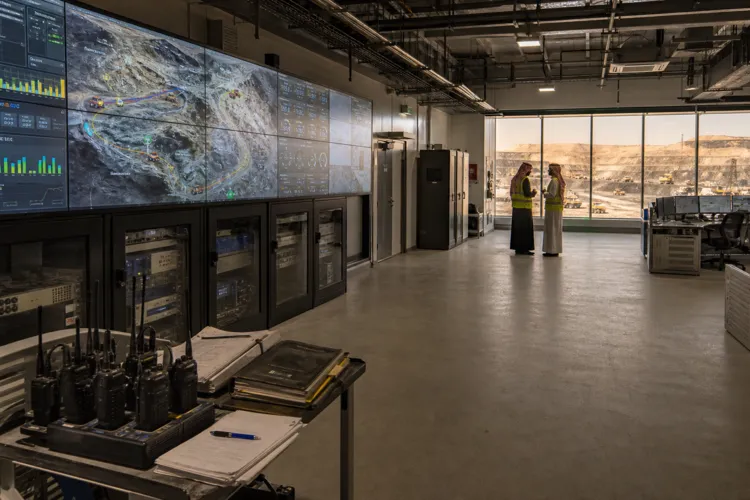
Saudi Arabia is also highlighting its “underexplored potential of the Arabian Nubian Shield” to global investors. Research discussing the Arabian Shield points to untapped critical minerals such as Cu, Li, Co, and Ni, and states that AI and remote sensing enhance exploration of the Arabian Peninsula’s mineral potential. In parallel, autonomous trucks, drones, and robotic systems are becoming more integral to operations, with AI-driven drones and robotics supporting more accurate analysis of geological structures and mineral deposits.
How does AI in mineral exploration speed up discovery in Saudi Arabia?
Which Vision 2030 mining targets are linked to technology adoption?
What data sources can AI workflows use for targeting in Saudi Arabia?
What minerals are discussed in the sources related to Saudi exploration potential?