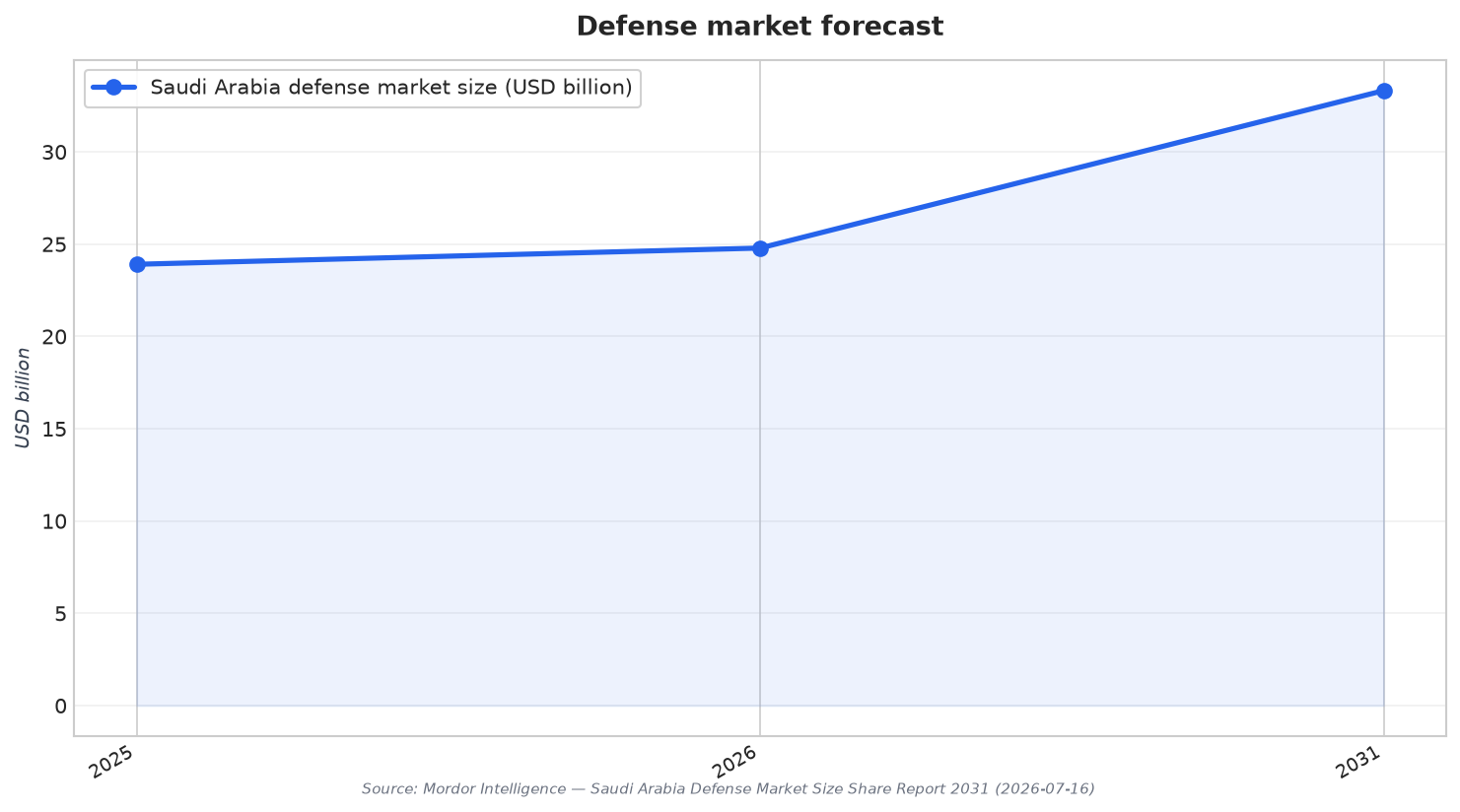
Saudi Arabia’s defense trajectory is moving upward, and that matters when supply chains tighten around defense-critical materials. IMARC Group values the Saudi Arabia defense market at USD 24,034.8 million in 2025 and expects it to reach USD 33,077.1 million at a 3.61% CAGR during 2026–2034. Trading Economics data cited by IMARC also puts military spending at USD 80,330.70 million in 2024, up from USD 77,765.30 million in 2023. In parallel, Vision 2030 policy targets are explicit about localization. GMI Research and the U.S. International Trade Administration both state that Saudi Arabia aims to localize 50% of its military procurement by 2030, under the aegis of GAMI and SAMI.
The case for looking at antimony is rooted in global market stress, not in any source-verified estimate of domestic Saudi antimony production. Mordor Intelligence values the global antimony market at 126.99 kilotons in 2025 and estimates growth from 129.12 kilotons in 2026 to 140.27 kilotons by 2031, a 1.67% CAGR for 2026–2031. The same report says a rapid price escalation exposed structural reliance on Chinese supply, and that China’s December 2024 export ban doubled benchmark prices. It also notes that strategic demand is pivoting toward energy storage, semiconductor doping, and defense electronics, where antimony’s metallurgical and electronic properties have few substitutes. This is the security-of-supply backdrop around any “antimony Saudi Arabia” discussion.
Why Defense Localization Raises the Stakes for Inputs
Localization targets can make upstream inputs more consequential, because local assembly and MRO still depend on reliable materials and components. Mordor Intelligence reports foreign acquisitions accounted for 80.50% of Saudi Arabia’s 2025 defense budgets, while indigenous production is forecast to grow at an 11.40% CAGR through 2031. It also states localization climbed from 4% in 2018 to 24.89% by the end of 2024, adding more than 800 direct jobs through National Guard contracts alone. In February 2024, GMI Research notes the Ministry of Defense signed 19 contracts and two MoUs at World Defense Show 2024 to enhance readiness and support localization, including agreements with firms such as LIG Nex1, Raytheon Technologies, SAAB, and Thales.
Saudi Arabia’s modernization story is also shaped by the structure of spending and the kinds of capabilities emphasized. Mordor Intelligence reports the Air Force led spending with a 38.19% share in 2025, and air represented 36.90% of 2025 expenditure. Space is projected to grow at a 10.35% CAGR through 2031, driven by Neo Space Group programs. GMI Research adds that Saudi Arabia ranked 3rd globally among arms importers between 2021 and 2025, and that the U.S. was the largest supplier with 77% of total arms imports. In this environment, building resilience against sudden export controls in any upstream market becomes a strategic planning issue.
So, can Saudi Arabia help close a defense-critical antimony supply gap? The sources do not quantify Saudi antimony resources or output, so any conclusion must stay at the level of industrial logic and policy alignment. The policy architecture is clear: GAMI is the regulator, enabler, and licensor of military industries, while SAMI is a state-owned defense company launched by PIF in May 2017 to reduce reliance on foreign purchases. Meanwhile, the antimony market is heavily Asia-Pacific centered, with Asia-Pacific holding an 86.67% share in 2025, per Mordor Intelligence. The strongest near-term takeaway is that Saudi defense localization ambitions are rising at the same time global antimony supply security has tightened, making supply-chain planning more urgent even before new local mining facts are established.
Why is antimony supply security being discussed in a defense context now?
How large is the global antimony market, according to the sources?
What is Saudi Arabia’s defense localization target under Vision 2030?
How dependent is Saudi Arabia on foreign defense acquisition today?
What does the keyword topic of antimony and Saudi Arabia mean in practical terms here?