
Issues
A major mining operations company in Saudi Arabia overseeing multiple open-pit and underground assets required a structured approach to improve overall production efficiency and operational reliability. The client managed complex ore extraction operations across metallic and industrial minerals and was facing increasing expectations from regulators and stakeholders to demonstrate safety compliance, productivity improvements, and cost discipline. With rapidly growing output targets and evolving workforce requirements, the organization needed a production optimization strategy grounded in global mining best practices.
Solution
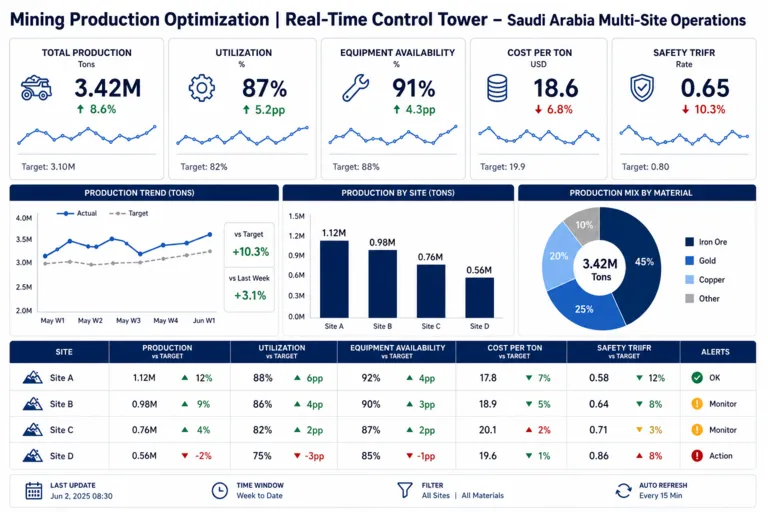
We developed a comprehensive operations and production enhancement program centered around improving equipment utilization, strengthening cross-functional coordination, and introducing data-driven decision-making tools. The program included designing a production control tower model that consolidated real-time operational data such as haul cycle times, drill-and-blast performance, equipment availability, and ore movement schedules. We introduced standardized operating procedures aligned with global mining productivity benchmarks and tailored them to the client’s terrain, workforce structure, and regulatory obligations. In addition, we established continuous improvement cycles that incorporated root-cause analysis, shift-level KPIs, and operational readiness assessments to address inefficiencies and enhance production reliability.
Approach
- Conducted on-site assessments of drilling, blasting, loading, and hauling processes to map out bottlenecks and quantify baseline performance variability across different operations.
- Designed a production control tower dashboard integrating real-time telemetry data, fleet management systems, and maintenance indicators to support rapid operational decision-making.
- Implemented standardized shift operating procedures governing blasting cycles, equipment dispatching, and ore movement tracking to minimize variance in daily output across crews.
- Facilitated cross-functional workshops bringing together operations, geology, and maintenance teams to align schedules, strengthen communication loops, and resolve chronic inefficiencies.
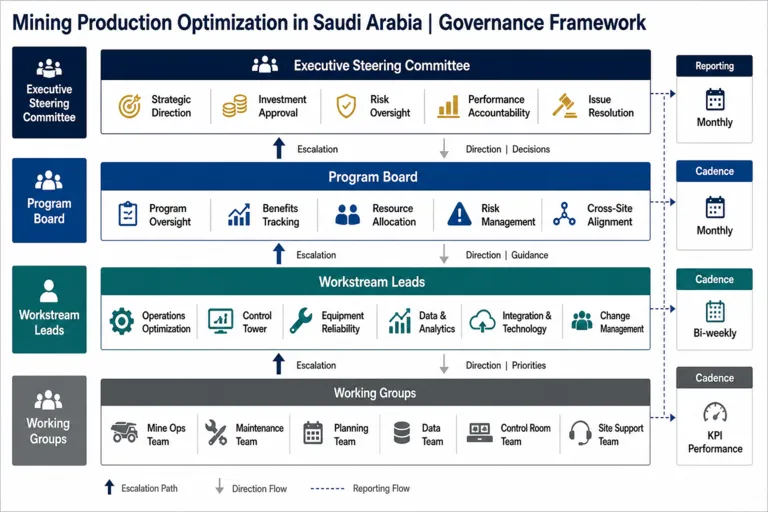
- Established a continuous improvement governance model incorporating weekly performance reviews, corrective-action planning, and skills development programs to institutionalize operational excellence.
Recommendations
- Deploy integrated fleet-telematics and predictive maintenance tools to reduce unscheduled downtime and ensure asset availability meets targeted production requirements.
- Establish a structured shift-level KPI framework tracking cycle times, tonnage moved, equipment idle hours, and drilling accuracy to improve accountability and performance consistency.
- Expand capability-building programs focused on operator proficiency, advanced equipment handling, and data literacy to empower frontline teams with the skills required for modern mining operations.
- Institutionalize cross-functional alignment sessions between geology, operations, and maintenance leadership to ensure cohesive planning of drilling, blasting, and hauling cycles.
- Leverage scenario-based production modeling to optimize equipment deployment strategies in response to changing orebody characteristics or market conditions.
Engagement ROI
The introduction of streamlined operating procedures and a real-time production control tower enabled the client to achieve a 19% improvement in equipment utilization across its primary sites. Hauling and loading cycle-time variability reduced by 24%, resulting in an annualized increase of 175,000 tonnes of processed ore. Predictive maintenance protocols lowered unscheduled equipment downtime by 17%, avoiding approximately SAR 9.8 million in potential production losses. Enhanced shift-level accountability and skills development programs improved operator performance consistency, contributing to a measurable 12% reduction in cost per tonne.