
Issues
A national geological organization responsible for mapping Saudi Arabia’s mineral potential sought support to enhance its resource exploration and assessment methodologies. The client oversaw large-scale geological surveys, remote sensing programs, and early-stage exploration activities across metallic, nonmetallic, and strategic minerals. With increasing demand for accurate geological insights to inform national mining strategies, the organization aimed to modernize its exploration workflows and improve resource classification accuracy across diverse terrains.
Solution
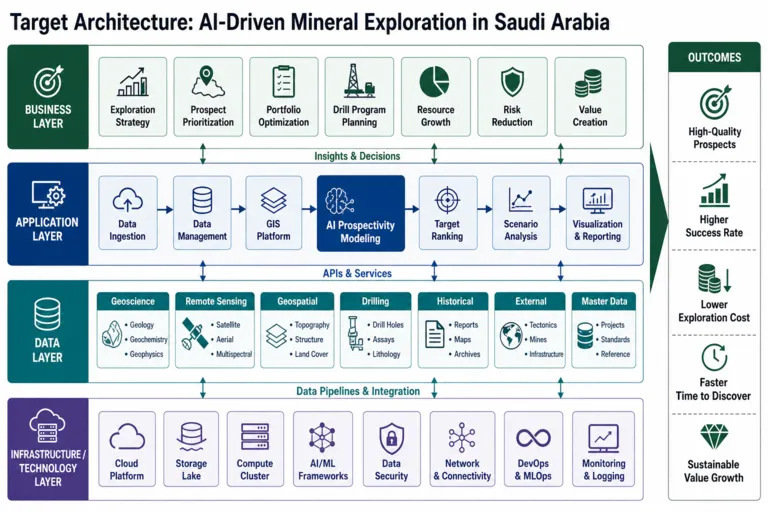
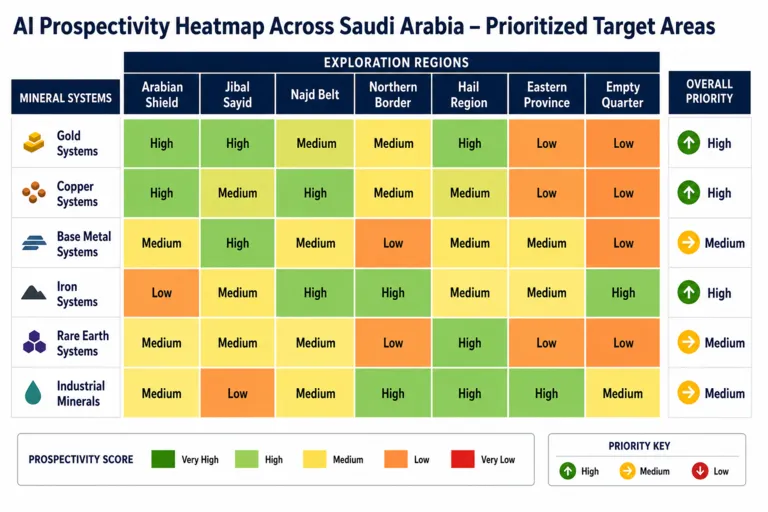
We developed an integrated resource exploration and assessment modernization program to enhance geological modeling, improve dataset interoperability, and strengthen early-stage mineral identification accuracy. This included designing a unified exploration data architecture, implementing advanced remote sensing techniques, and introducing AI-augmented prospectivity modeling to highlight high-value targets. We standardized field-collection protocols and created training programs to improve data reliability. A multi-criteria evaluation framework was established to rank prospects based on geological confidence, accessibility, economic viability, and regulatory considerations.
Approach
- Conducted a comprehensive audit of historical datasets, remote sensing archives, and geophysical logs to identify gaps and define new data integration standards across the organization.
- Built unified exploration data architecture enabling seamless integration of geological, geochemical, structural, and geophysical layers into a centralized GIS platform.
- Developed AI-driven prospectivity models using pattern recognition and anomaly detection algorithms to highlight regions with favorable mineralization signatures.
- Standardized field sampling procedures, data collection tools, and reporting practices to improve dataset quality and enhance consistency across survey teams.
- Designed a national prospect ranking framework incorporating geological confidence levels, environmental constraints, infrastructure availability, and estimated exploration costs.
Recommendations
- Institutionalize the unified exploration data architecture as the national standard to ensure long-term comparability and interoperability of geological datasets.
- Expand investment in AI-enabled modeling tools and remote sensing capabilities to accelerate identification of promising mineral zones across underexplored areas.
- Strengthen capacity-building initiatives aimed at improving field-team technical skills, digital literacy, and ability to utilize advanced mapping tools.
- Establish a national geological knowledge-sharing platform enabling stakeholders to access non-sensitive data and foster collaborative mineral development planning.
- Implement periodic dataset validation cycles to ensure all geological models remain accurate as new field data and remote sensing inputs become available.
Engagement ROI
The modernization program reduced exploration cycle times by 26% by improving dataset integration and accelerating target identification. The AI-driven models increased accuracy of mineral prospectivity predictions by 28%, enabling more effective resource allocation toward high-potential zones. Standardized field protocols improved data reliability by 22%, reducing rework and unnecessary re-sampling costs. Overall, the client achieved operational savings of approximately SAR 12.8 million over the first year, while strengthening national strategic readiness for large-scale mineral development.