
Issues
A leading mineral exploration organization operating across multiple geological provinces in Saudi Arabia sought to strengthen its early-stage exploration decision-making and reduce uncertainties associated with identifying commercially viable deposits. The client managed a diverse exploration portfolio across metallic and industrial minerals and required advanced assessment methodologies to prioritize high-potential sites. Facing increasing pressure from investors and regulatory stakeholders, the organization sought a structured, data-driven approach to enhance its exploration maturity and accelerate feasibility readiness.
Solution
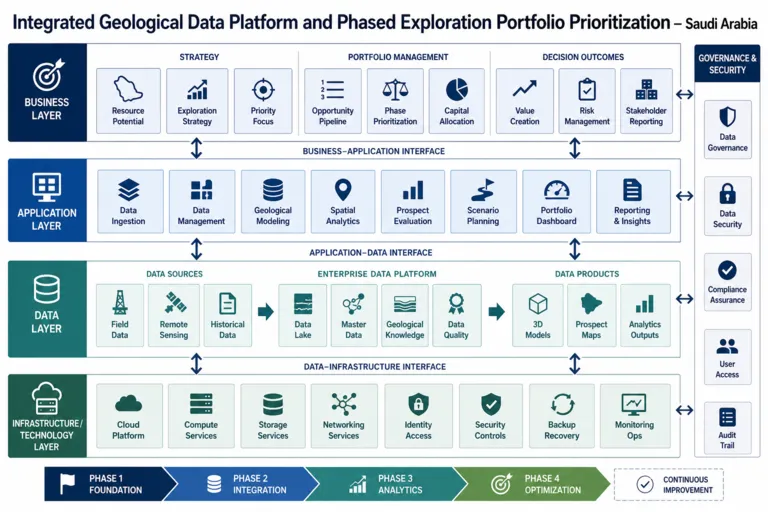
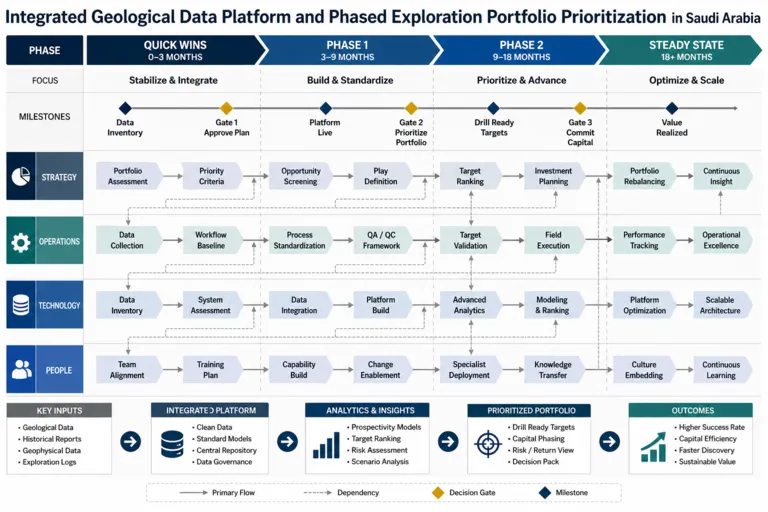
Our consulting team designed a comprehensive mineral exploration and resource assessment framework to optimize early-stage decision-making and improve resource classification accuracy. This included establishing a unified geological data platform integrating GIS layers, drill core analytics, remote sensing, and geophysical signatures. We introduced probabilistic modeling techniques to determine orebody continuity and used machine-learning algorithms to identify anomalies correlated with successful past discoveries. A multi-criteria decision matrix was developed to evaluate geological potential, accessibility, environmental constraints, and cost-to-develop metrics. Through a phased roadmap, we aligned exploration sequencing with regulatory submissions, investor expectations, and capital allocation plans to ensure improved prioritization of high-value targets.
Approach
- Conducted an extensive audit of existing geological datasets, geophysical surveys, and drilling logs to identify inconsistencies and establish a standardized exploration data architecture used across all sub-regions.
- Built an integrated GIS-enabled exploration platform consolidating historical geological records, interpreted structures, mineralization trends, and geospatial constraints for cross-functional validation.
- Developed a risk-scoring and economic attractiveness model incorporating geological confidence intervals, extraction challenges, environmental sensitivity, and projected development economics to rank all prospects.
- Facilitated workshops with field geologists, data scientists, and investment teams to refine exploration sequencing and ensure the model aligned with operational, financial, and regulatory realities in Saudi Arabia.
- Designed an implementation roadmap detailing capacity-building requirements, governance procedures, and annual reassessment cycles to update the resource portfolio in response to new findings.
Recommendations
- Adopt a centralized exploration governance model that mandates standardized data formats, geological interpretations, and monthly portfolio reviews to avoid data fragmentation across multiple teams and contractors.
- Implement continuous upskilling programs for geologists and field supervisors focused on advanced analytical tools, probabilistic modeling, and digital interpretation techniques to strengthen data quality at source.
- Institutionalize a structured pre-feasibility readiness assessment that evaluates economic, regulatory, environmental, and logistical factors before approving additional drilling investments.
- Introduce annual exploration portfolio rebalancing sessions to reassess economic potential, ensuring capital expenditure flows toward high-promise opportunities aligned with national mining priorities.
- Leverage digital core-logging systems and remote sensing updates to maintain a real-time view of exploration maturity and proactively mitigate duplicative drilling or operational inefficiencies.
Engagement ROI
The implementation of the integrated exploration and resource assessment framework enabled the client to reduce exploration uncertainty by an estimated 22%, driven by more accurate orebody modeling and improved geological dataset integration. Drilling optimization initiatives lowered redundant drilling campaigns by 18%, generating cost savings of approximately SAR 11.4 million over the first year. Portfolio prioritization efforts accelerated the advancement of two key prospects into pre-feasibility stages nearly six months earlier than initially planned. The improved transparency and standardization enhanced investor confidence, resulting in a 15% increase in committed exploration funding for the upcoming cycle.